
What 3D-printed LEGO parts teach us about Connector Pairs (#10361 Holiday Express Train)
Let’s explore how The LEGO Group used more tolerant connector pairs for their first tentative steps to include 3d-printed parts in official LEGO sets.

#10361 Holiday Express Train is the first commercially-available LEGO set to include an official 3D printed LEGO element. That said, there were three previous 3d-printed parts, but they were available to a select few LEGO fans. All four of these known parts have something in common – they eschew the familiar stud and tube in favor of alternate connectors.
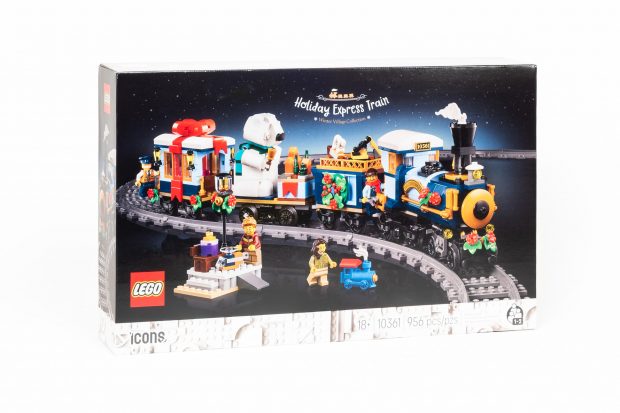
#10361 Holiday Express Train is the first widely distributed LEGO set to include a 3d-printed part.
In this article, we will find out which connector pairs are used in these 3d-printed parts, and why these connector pairs were likely chosen. Lastly, we will close with a brief review of #10361 Holiday Express Train itself.
Connector Pairs?
One of the key topics in my upcoming book “The LEGO Parts Guide” are connector pairs – the many different ways that two LEGO parts can connect to one another. Classic LEGO bricks rely on the Stud and Tube connector pair, but there are so many more… Technic Pin / Pin Holes, Ball Joints, Sockets, and Stem / Stem Holes to name a few.
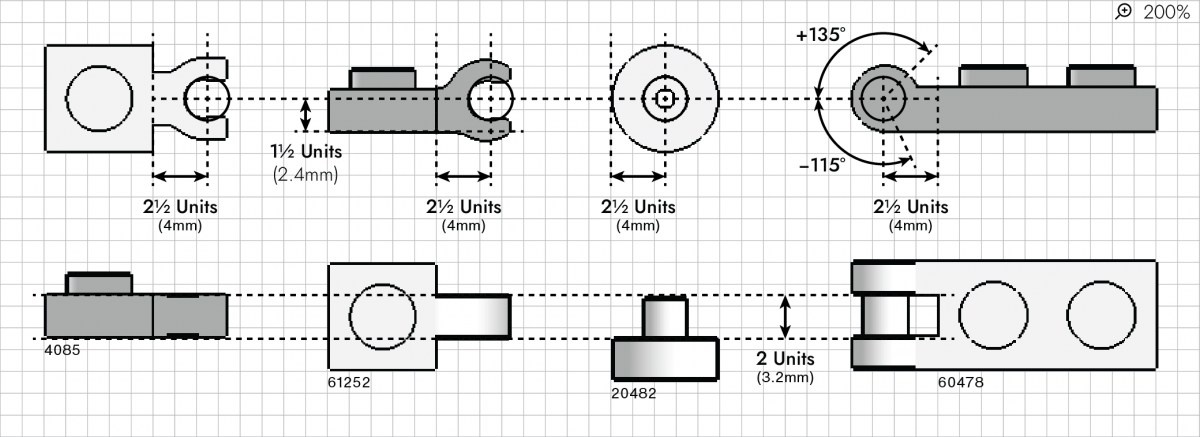
Draft illustration from my upcoming book ‘The LEGO Parts Guide’ showing the Clip/Bar Connector Pair .
I suspect that the second most common connection pair is the Bar / Clip, which was popularized by the LEGO Minifigure’s hands and numerous accessories. In practice, a Bar/Handle is just a cylinder that is 3-units (4.8mm) in diameter, and a Clip bends slightly to grab it.
A brief history of 3D Printed LEGO Parts
It’s been more than 10 years since 3d-printers became fairly common in the homes of hobbyists, but 3d-printing remains somewhat niche because 3d printed parts are not nearly as precise as parts produced using other techniques such as injection moulding – which is used to produce LEGO bricks. Nonetheless, The LEGO Group has been experimenting with 3d-printing as a prototyping tool for a very long time.
Drafting Arm
The first 3d printed part available to consumers was a simple Drafting Table Arm (Part 66237) which was released in 2019. That said, it was only available in an extremely rare LEGO set provided to about 100 LEGO fans who took that year’s LEGO Inside Tour.
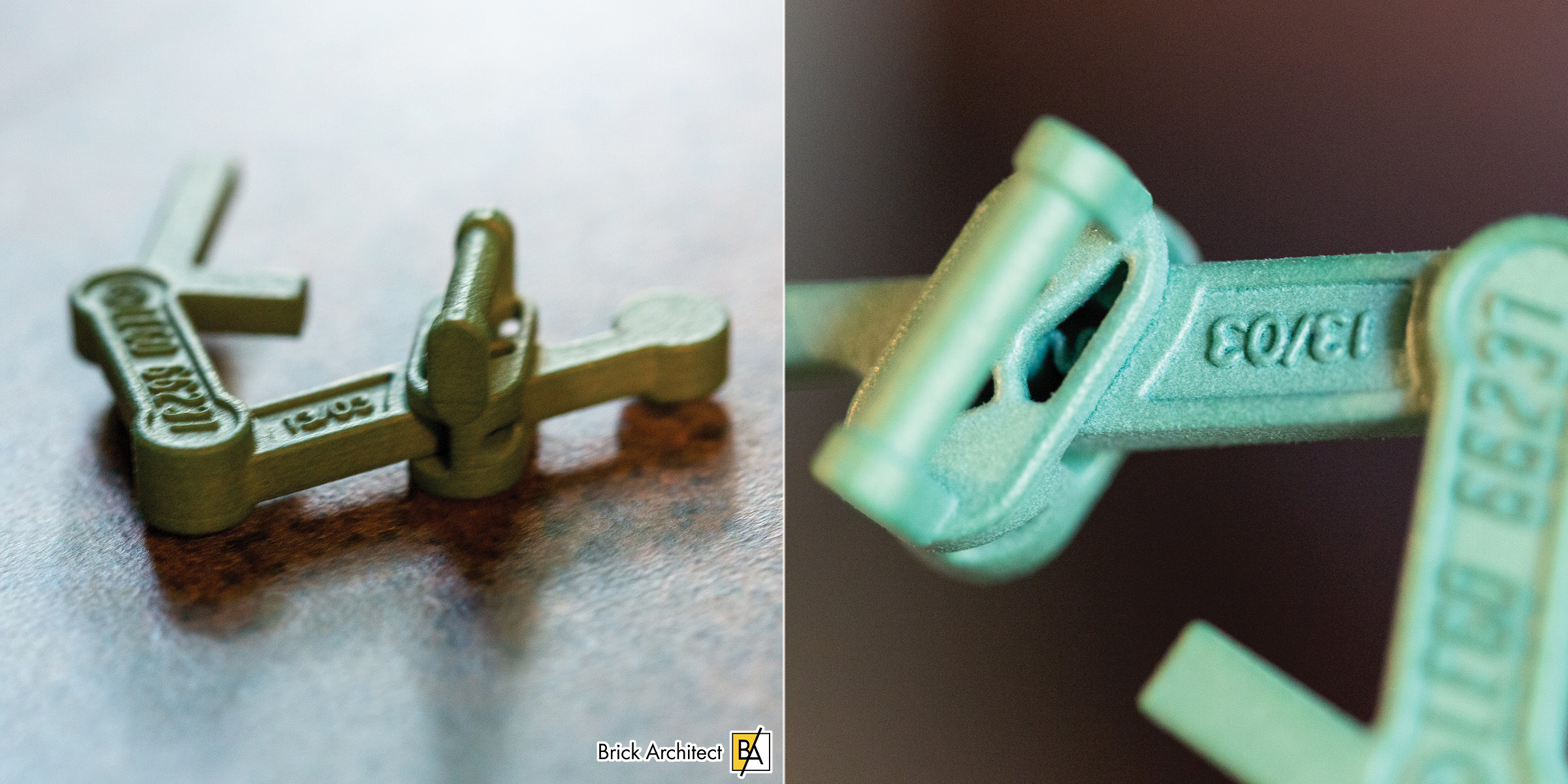
#66237 Drafting Arm was the first official 3d-printed LEGO element. It has a small “s” shaped spring that allows the arm to bend after being clipped into place.
The simple part has a handle on the bottom that’s two-studs long and looks similar to 1×2 Plate w/ Handle, Side (Part 48336). It connects to the drafting table using a pair of clips. I suspect two clips were used to ensure the connection was strong enough even if the diameter of the 3d-printed part is slightly too small.
One detail that is not widely known about this part is that it features a small spring inside which allows you to bend the drafting arm after it is attached. This would be difficult to achieve using traditional injection moulding but is possible with 3d-printed parts.
Duck
Three years later, the second 3d-printed part was available in slightly larger quantities as a gift-with-purchase for those AFOLs attending Skærbæk Fan Weekend in September 2022. Pull-Along LEGO Duck (Part 107401) features a small duck inspired by an early wooden toy produced by LEGO.
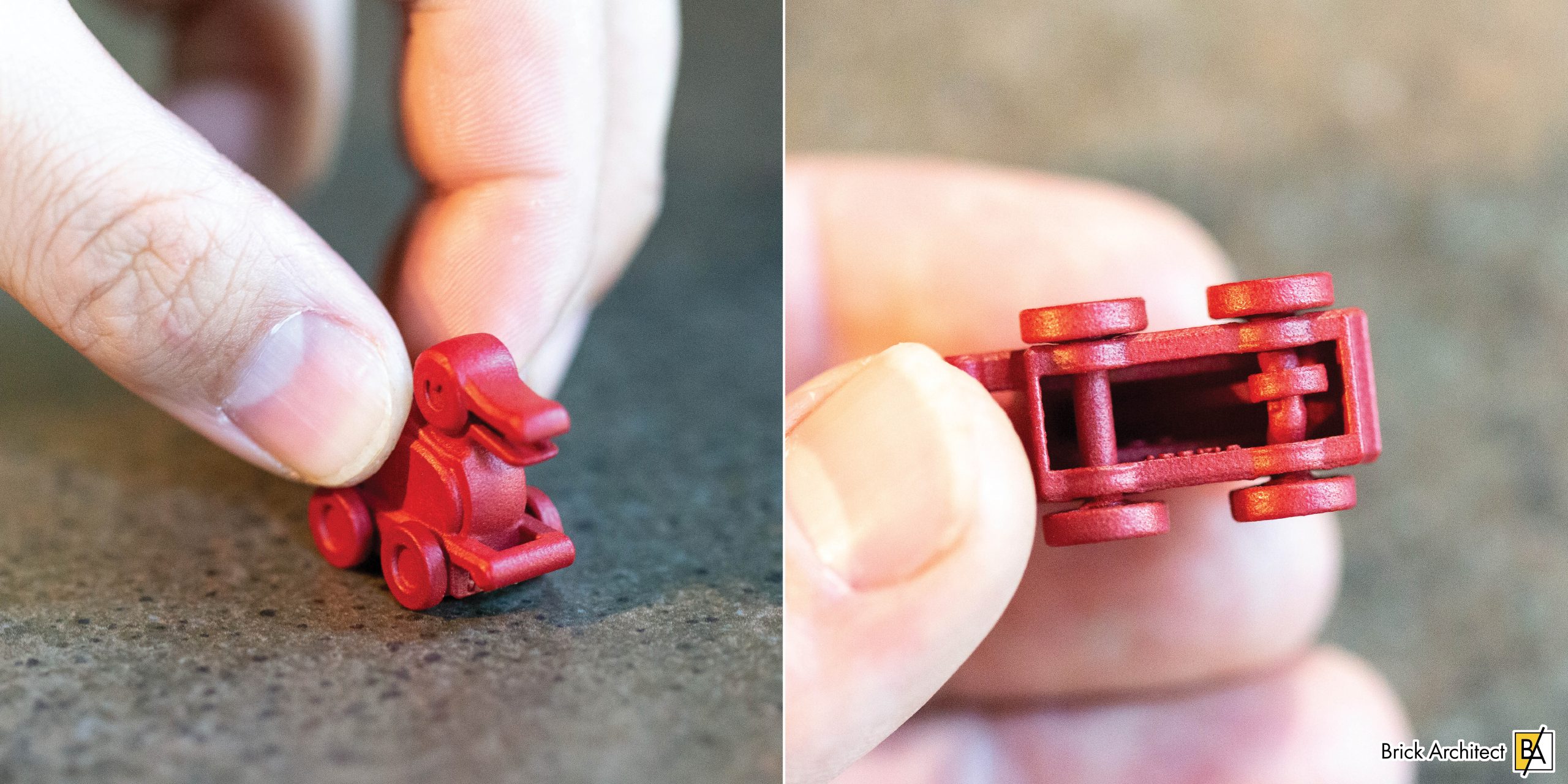
The duck’s beak opens and closes as you pull it across a table.
Because it is 3d-printed, the beak opens and closes like the classic toy, thanks to an armature which connects to the beak from a bend in one of the wheels. Again, the only connector on this part is a bar across the front which can be grasped by a clip or a minifigure’s claw-shaped hands.
Pogo Stick
Finally, a small number of Pogo Stick (Part 79507) were made available as a bonus for crowdfunding supporters for Daniel Konstanski’s book “The Secret Life of LEGO Bricks”. It was delivered alongside the book to supporters in November 2022.
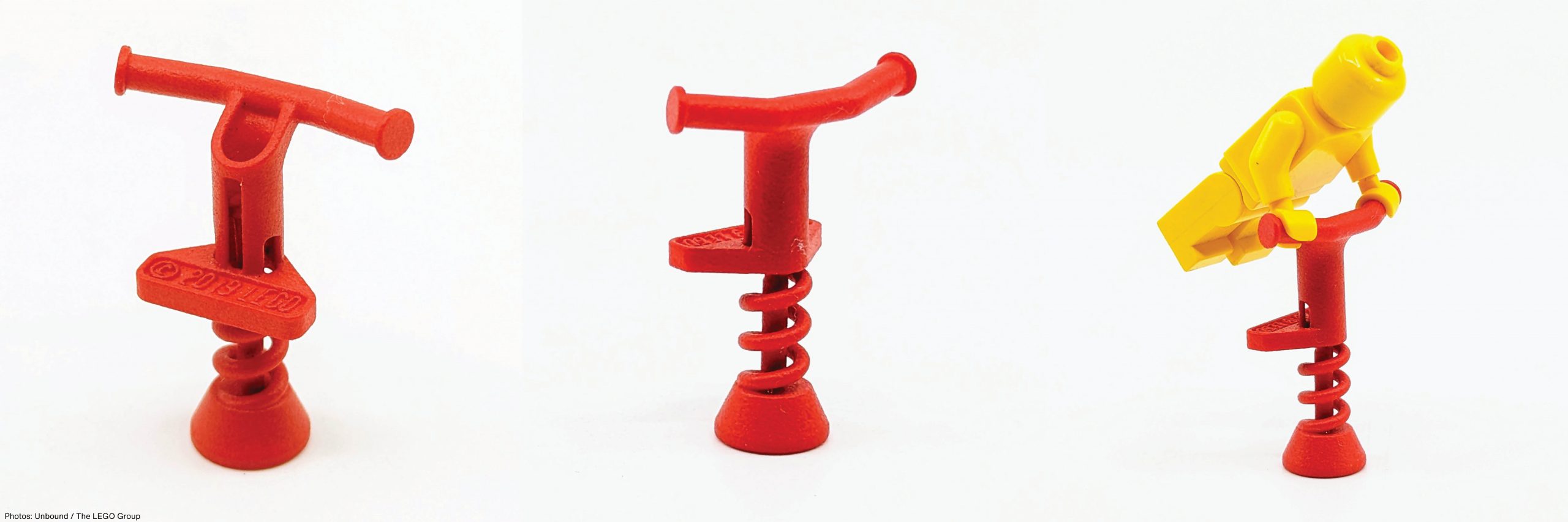
The Pogo Stick also relies on a ‘Handle’ Connector for the Minifigure to hold on. (Photos: Unbound / The LEGO Group.)
The pogo stick also features a spring-like mechanism which causes the pogo stick to bounce when a minifigure is attached on top. This time, it included two bar connectors so a minifigure can hold on to the pogo stick with both hands. While it would make sense to have studs where the figure stands, it does not… relying only on the bars attached to the figure’s hands.
Closer Look: Toy Train (Part 112073)
Fast forward to 2025 and we finally have the first commercially available LEGO set to include a 3d-printed part is here! #10361 Holiday Express Train includes a tiny 3d-printed train with wheels that actually rotate and smoke that goes up and down when you push it along a surface.
I find it interesting that all three of the previous limited-release 3d-printed LEGO parts, plus this more widely available part do not leverage the iconic Stud and Tube connection. As with the previous parts, this new one relies heavily on the Bar or Handle connector type. I strongly believe this is used because clips are more tolerant of subtle differences in diameter than studs.
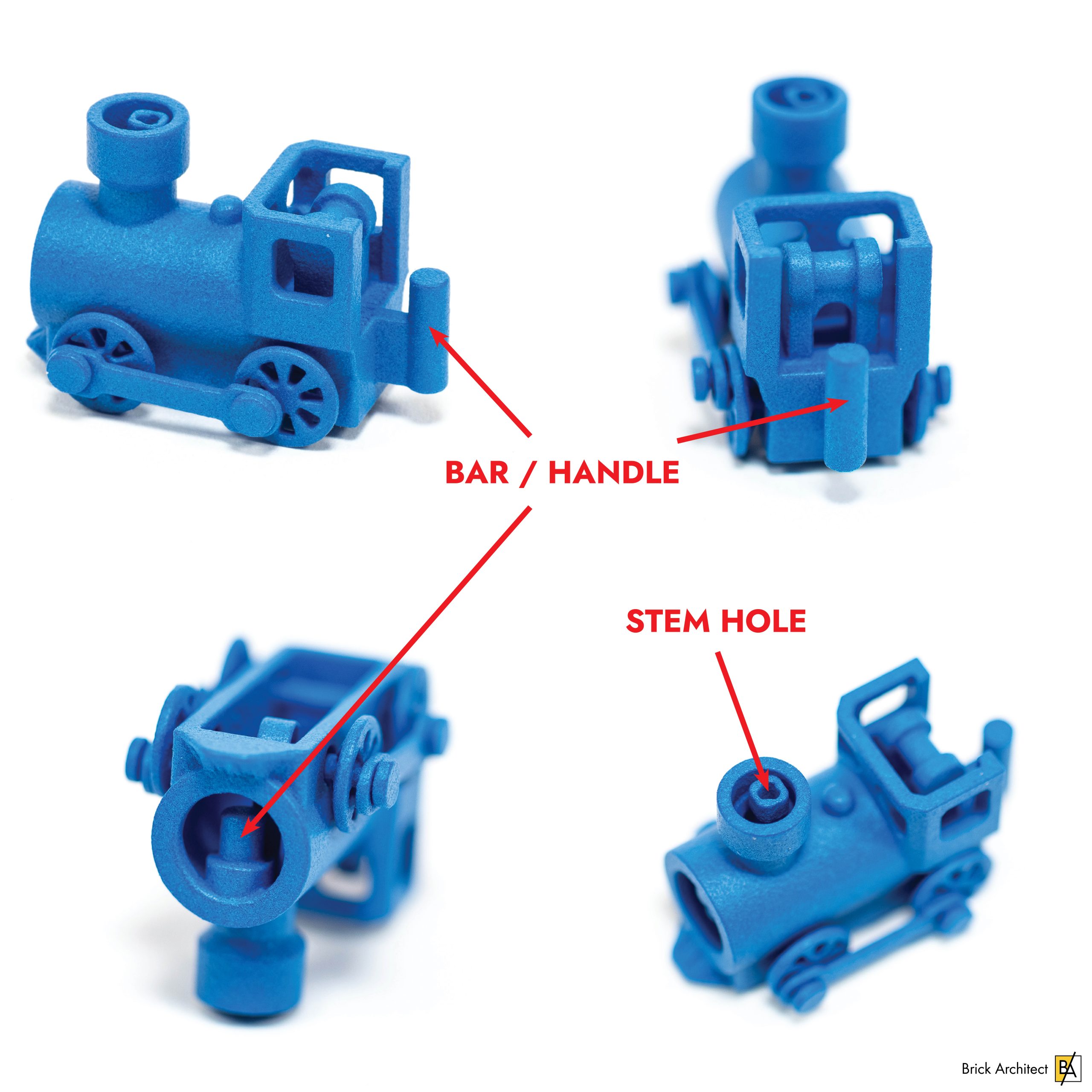
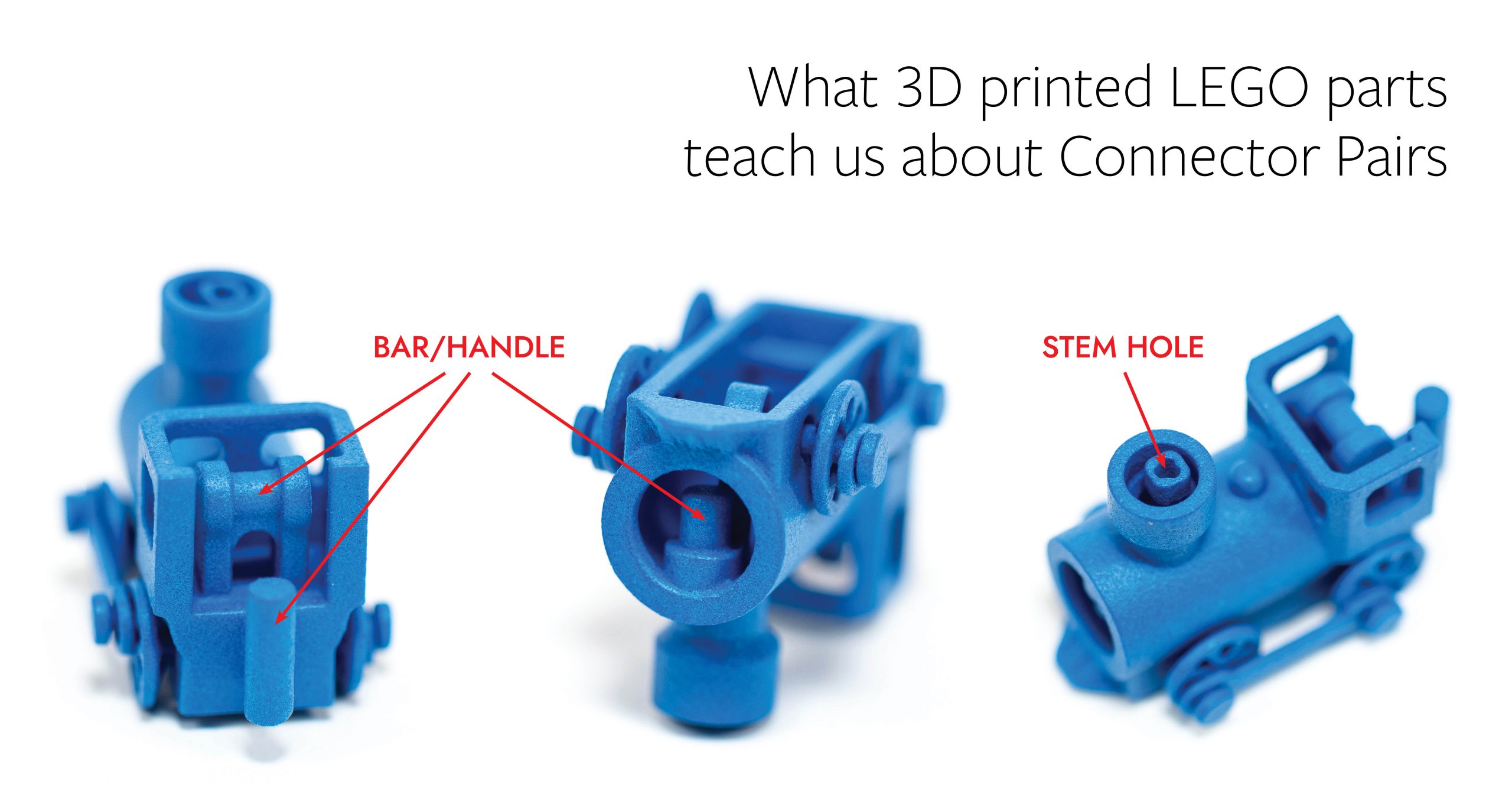
The train has three bar/handle connectors, and one stem hole.
What is more surprising to me is the addition of a second connector type for the first time in a 3d-printed part. A bar extends up the smokestack with a stem-hole on the end. This is used to attach a smoke-like plume which moves up and down when pushed across a surface. It uses a similar mechanism to the one that makes the duck’s beak open and close.
Unlike the round stem hole on injection-moulded LEGO parts, this one has a clearly visible three-pointed pattern on the hole. Having exactly three points of contact makes it easier for part designers to ensure desired clutch power for every piece. By making the contact points narrower, it is likely that the 3d-printed material will deflect slightly if the hole is ever-so-slightly smaller than a normal stem hole.
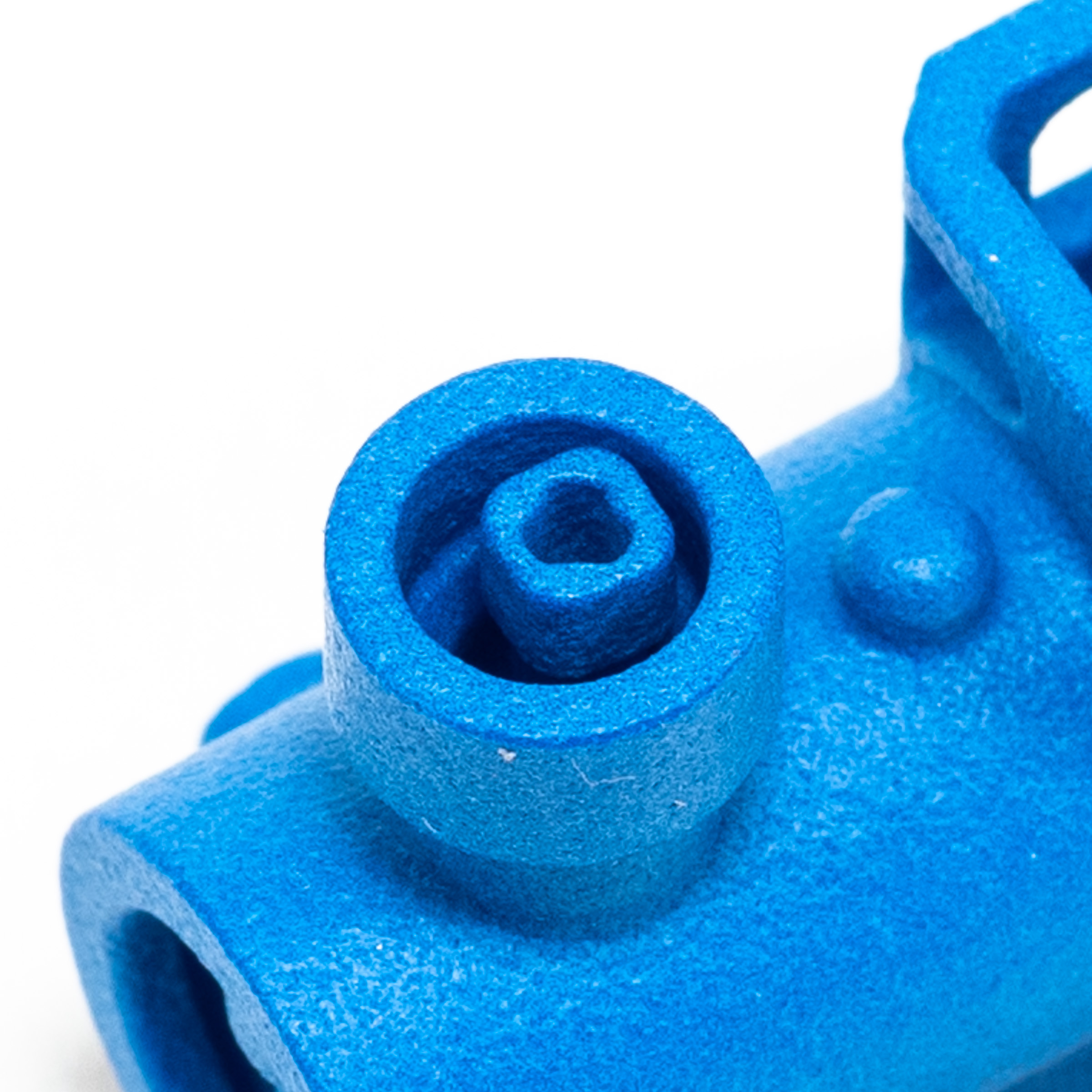
The 3d-printed ‘Stem Hole’ is not perfectly round.
The state of 3d-printing at The LEGO Group
What Toy Train (Part 112073) tells me about 3d-printing technology at The LEGO Group is that they are continuing to refine the process in terms of both precision and scale. When it comes to precision, the new part has both more bar/handle connectors than earlier 3d-printed parts, as well as a new connector type that is likely harder to refine because it has just three points to grasp very slender parts with a precise diameter.
Review: #10361 Holiday Express Train
Because the focus of this article is on the state of official 3d-printed LEGO parts, this review is pretty short. The set comprises of just 6 numbered bags, plus enough round track to make a circle. (I personally have no use for additional round track and would have loved to receive even just a couple straight sections.)
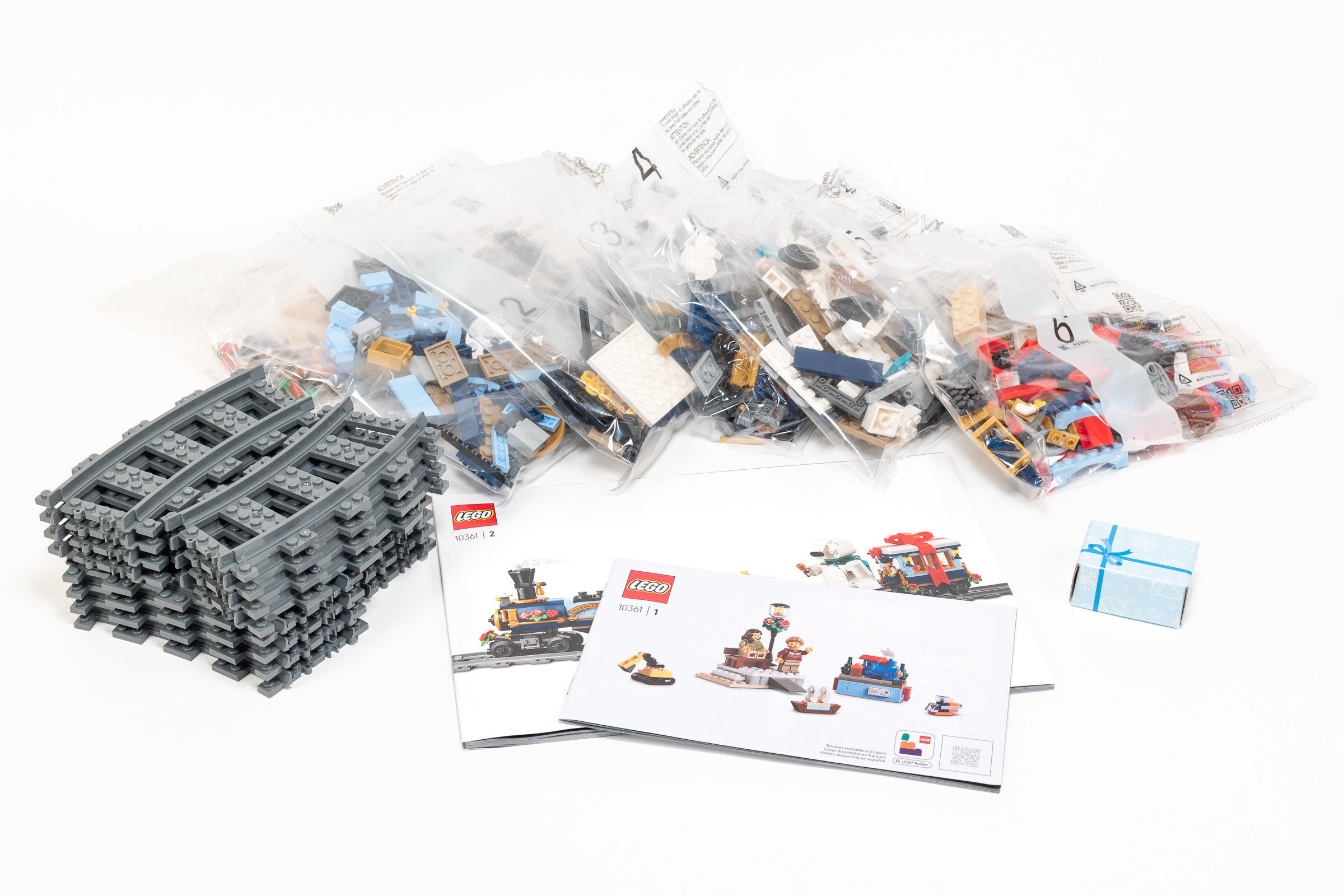
The 956 piece set only includes 6 numbered bags.
Build Process
The first bag comes with its own small instruction booklet. In it, we build a tiny loading platform and three brick-built toys. More relevant to this article, there’s also a small platform where the 3d printed train can be displayed. As noted earlier, a plume of smoke connects to the train using a stem hole connector, and a pair of handles on the train are converted into outward-facing studs using 1×1 Round w/ Clip, Bottom (Part 5264). The one on the front remains unadorned, and the one above the cab is covered by a 45° 2×2 Double Slope (Part 3043) in 21Bright RedRed.
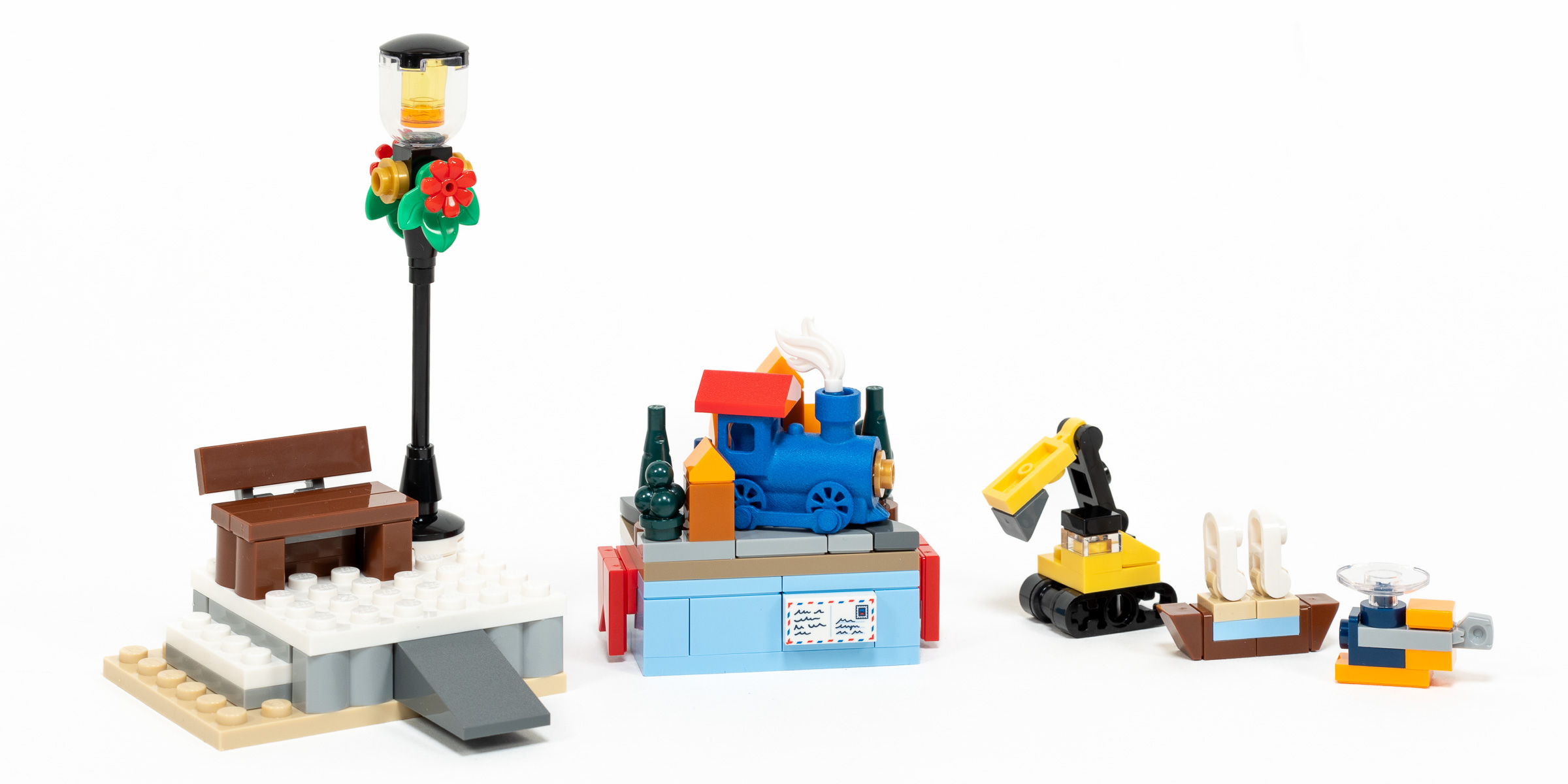
Building smaller vignettes and toys in Bag 1.
The second bag builds up the bulk of the locomotive engine. It’s mostly 6-studs wide, although there is a low protrusion right in front of the cab that extends to 8-studs wide. The combination of 140Earth BlueDark Blue and 212Light Royal BlueBright Light Blue looks striking, especially with the 297Warm GoldPearl Gold accents.
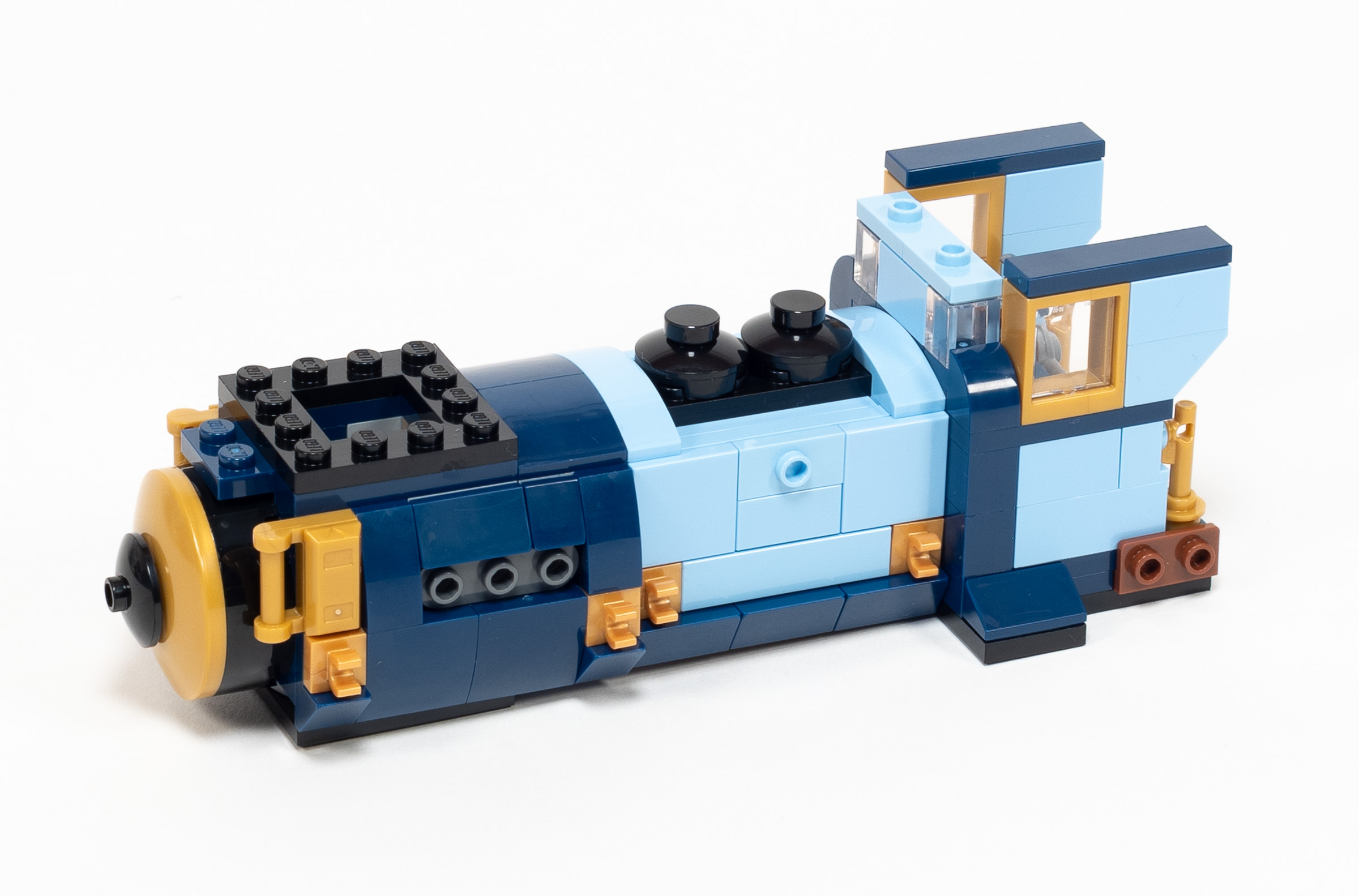
Half of the engine is built in Bag 2.
The third bag completes the train engine. There’s a simple mechanism that causes the smokestack itself to go up and down by 1/2 a stud (4mm) when the wheels rotate. There’s also some nice floral details on the side and a 4×4 Tile, Ø8 Corner w/ 3×3 Ø6 Cutout (Part 27507) printed with the words “Holiday Express”.
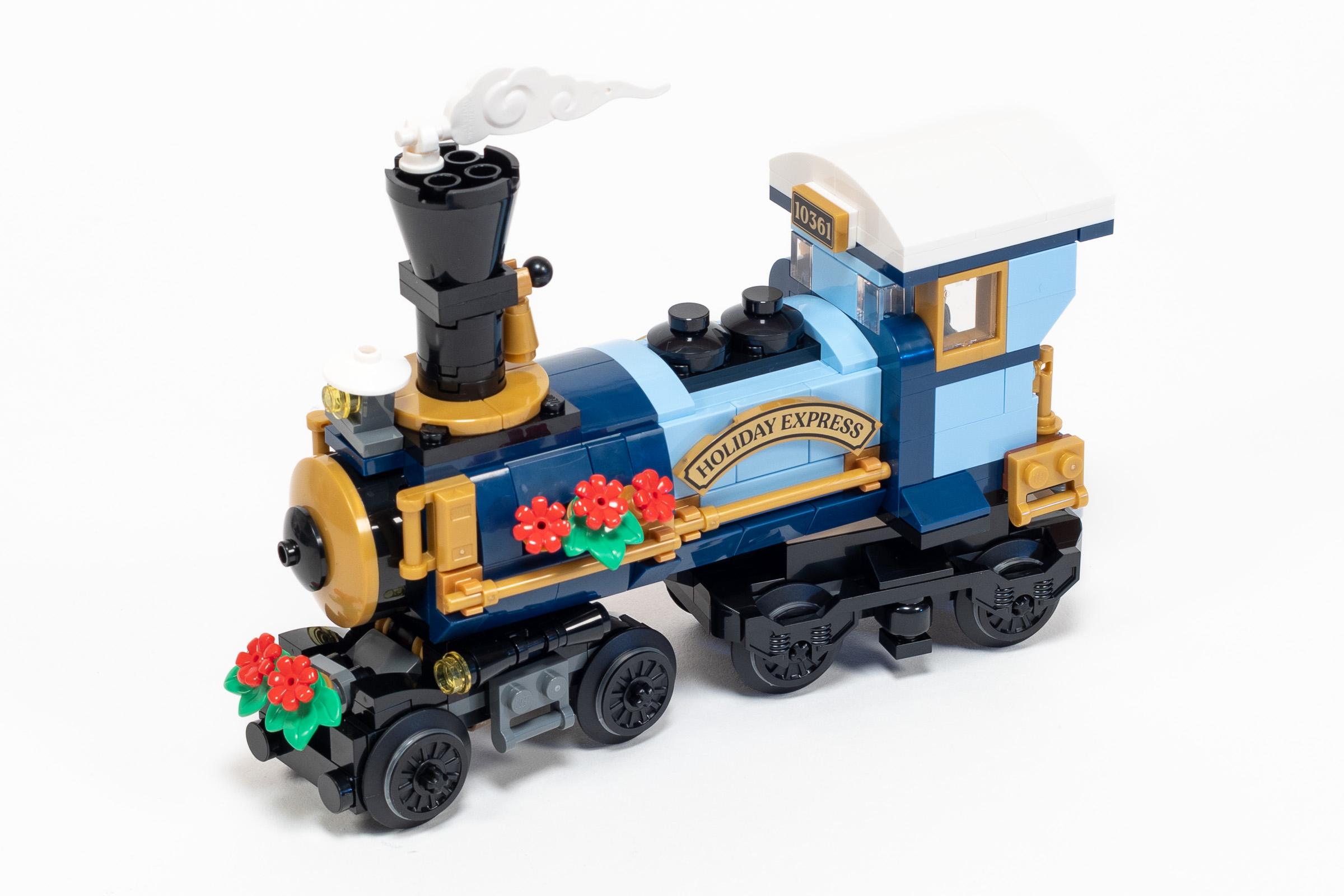
The engine’s color scheme is nice, and punctuated by the green and red accents.
The fourth bag is quick, since it involves a small car that follows the engine. In a historical context, this would be the coal car, but the real purpose in this model is to make the train a little longer — and to hide the battery box if you decide to motorize the set. (Motors and battery box sold separately.)
The last two bags include parts for two additional cars. The overall composition of the flatbed truck containing a polar bear feels unbalanced, but it is hard to dispute that the brick-built bear sculpture is cute, especially when you see the arms moving up and down as it goes around our Christmas tree.
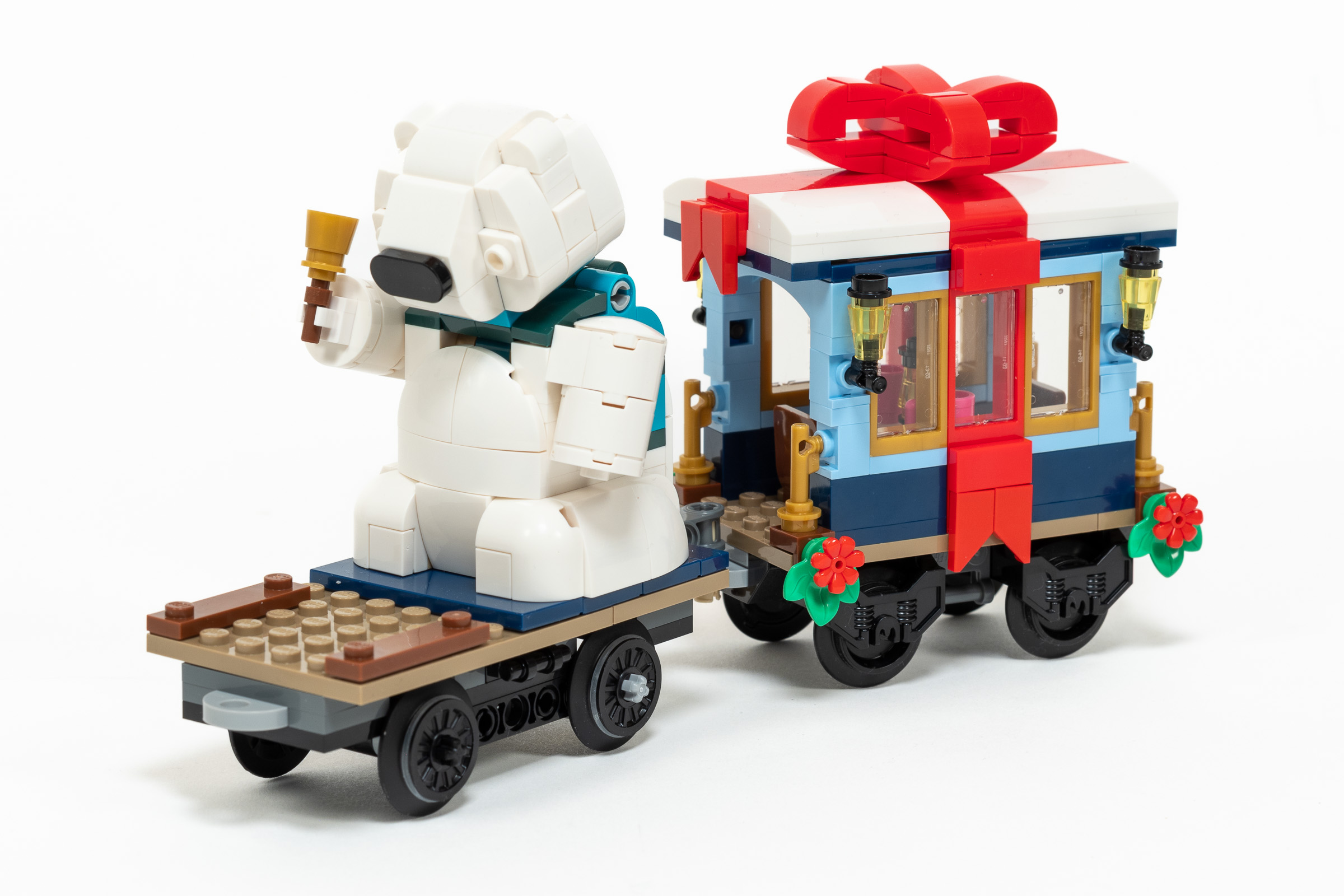
Flatbed Car with Polar Bear Statue, and Dining Car with Bow.
I do quite like the dining car’s exterior which has an oversized red ribbon wrapped around the car with a festive bow tied on the top. Inside, there’s just space for two people to enjoy a coffee.
Conclusion
#10361 Holiday Express Train is a decent addition to the Winter Village series. I prefer the blue color scheme of the newer train to the earlier #10254 Winter Holiday Train because it feels wintery and the red and green wreaths really stand out on a blue locomotive. I also really like the dining car with a big red bow around it. On the other hand, the earlier engine looks more impressive and I preferred the toy train going around the tree to the bear with arms that move up and down.
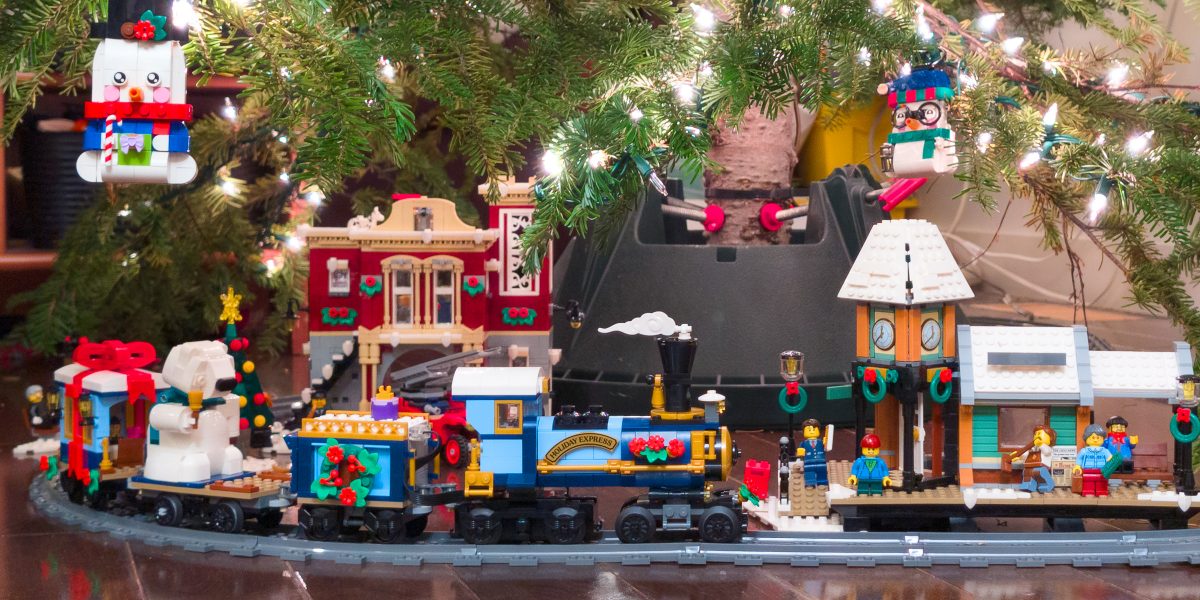
#10361 Holiday Express Train in a small Winter Village scene.
I also found it very frustrating to get the newer train to work with my Powered Up hub and motor. It seems like there isn’t enough weight in the engine so it ends up spinning its wheels. This can probably be remedied by placing the motor underneath the hopper instead of the engine, but the instructions did not suggest this approach and it was not entirely obvious how to make that change without additional parts and bigger changes to its design.
Since I am a bit disappointed by the train itself and the 3d-printed part isn’t a huge draw beyond the novelty, this set earns a meager Acceptable (2/5 star) rating. To be clear, it isn’t a bad set — I simply expect a bit more from the Winter Village series which has historically been excellent and a great value.