
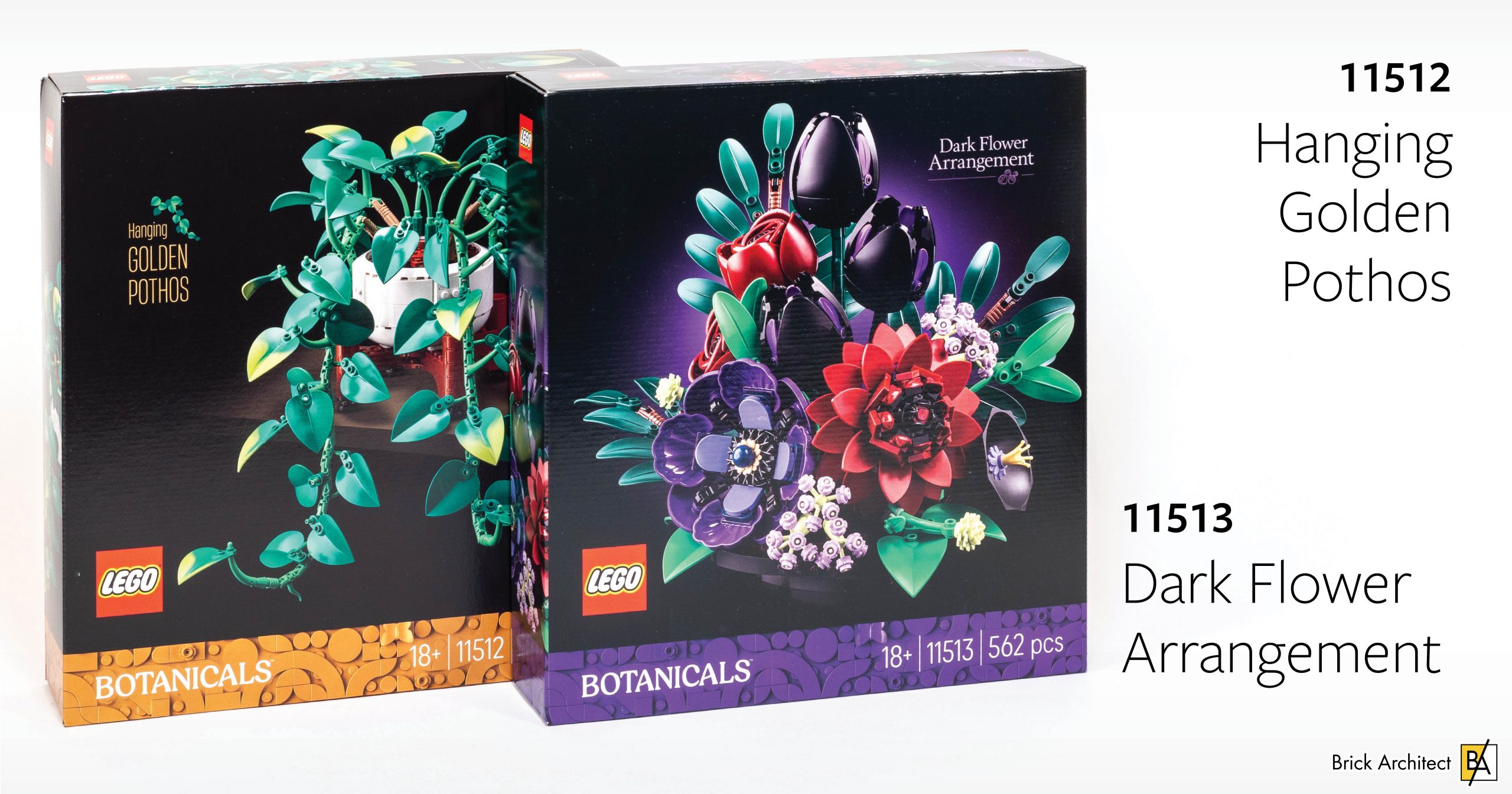
Review: #11512 Hanging Golden Pothos & #11513 Dark Flower Arrangement (Botanicals)
The two newest additions to the Botanicals lineup offer good building experiences, but very different vibes.

A large Golden Pothos is easily my favorite houseplat, as it sits atop shelves in my living room basking in the limited rays of Pacific Northwest sun. When I saw #11512 Hanging Golden Pothos, I was excited to blend two of my hobbies by displaying the brick-built version alnongside its real life variant. In this article, we will see a few of the creative new tecniques used by LEGO sets designers to translate these plants into LEGO form.
About the Sets
Two brand new LEGO Botanicals sets are coming out on August 1: #11512 Hanging Golden Pothos with 372 pieces, and #11513 Dark Flower Arrangement with 562 pieces. Both are priced at $59.99 (€59.99/£54.99).
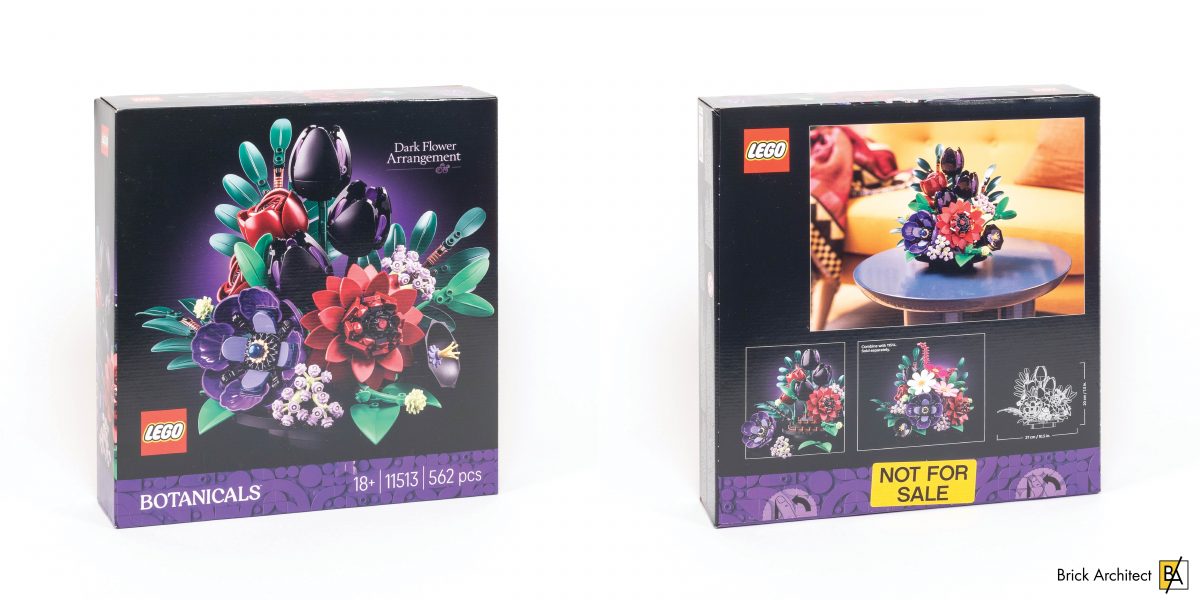
#11513 Dark Flower Arrangement – Box Front and Back.
#11513 Dark Flower Arrangement has a moodier aesthetic, centred around darker flowers in LEGO form. With 562 pieces, it has a price-per-part of $0.107 (€0.107/£0.098).
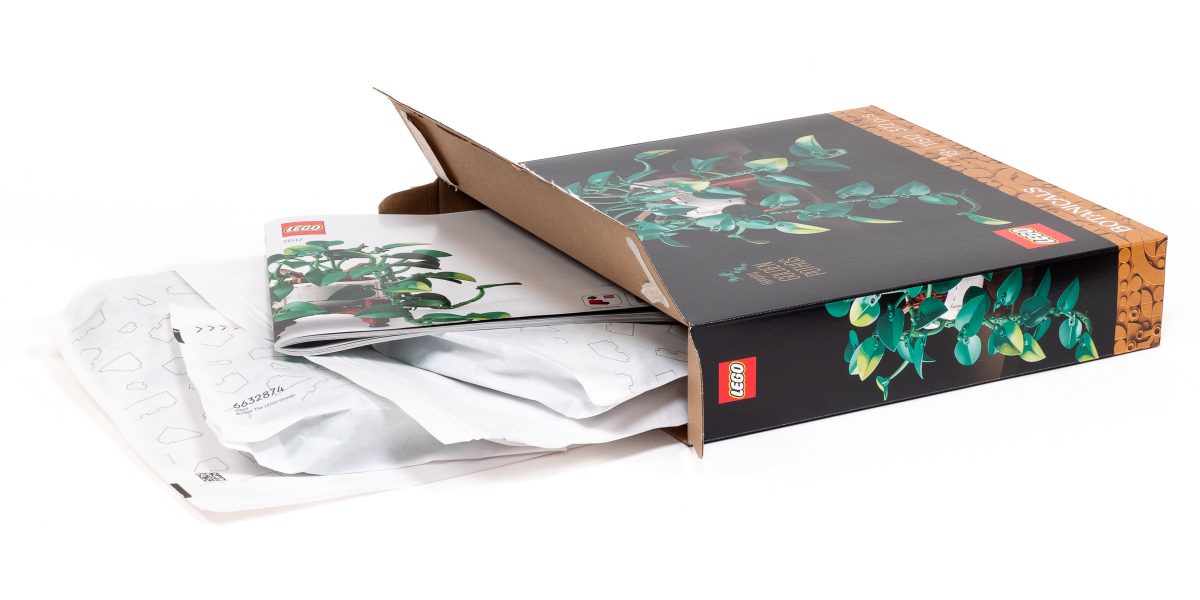
#11512 Hanging Golden Pothos contains four numbered bags.
This year, we also see the introduction of an indoor green thumb favorite, #11512 Hanging Golden Pothos with its variegated leaves and simple yet elegant pot. Because it only includes 372 parts, it has a price-per-part of $0.161 (€0.161/£0.148). It seems obviously overpriced, especially given it has no minifigures and a bunch of small parts. LEGO is definately taking advantage of the popularity of the plant with this pricing.
Hanging Golden Pothos
The Pothos is a hardy elegant climber plant from French Polynesia which is commonly found in houses of many budding green thumbs. This prolific plant is easy to care for and nurture and as such is popular amongst many. Its LEGO variant in the form of #11512 Hanging Golden Pothos is even easier to care for, while allowing for flexibility to build the vines to the owners’ desire.
Elegance Through A Pot And Stand
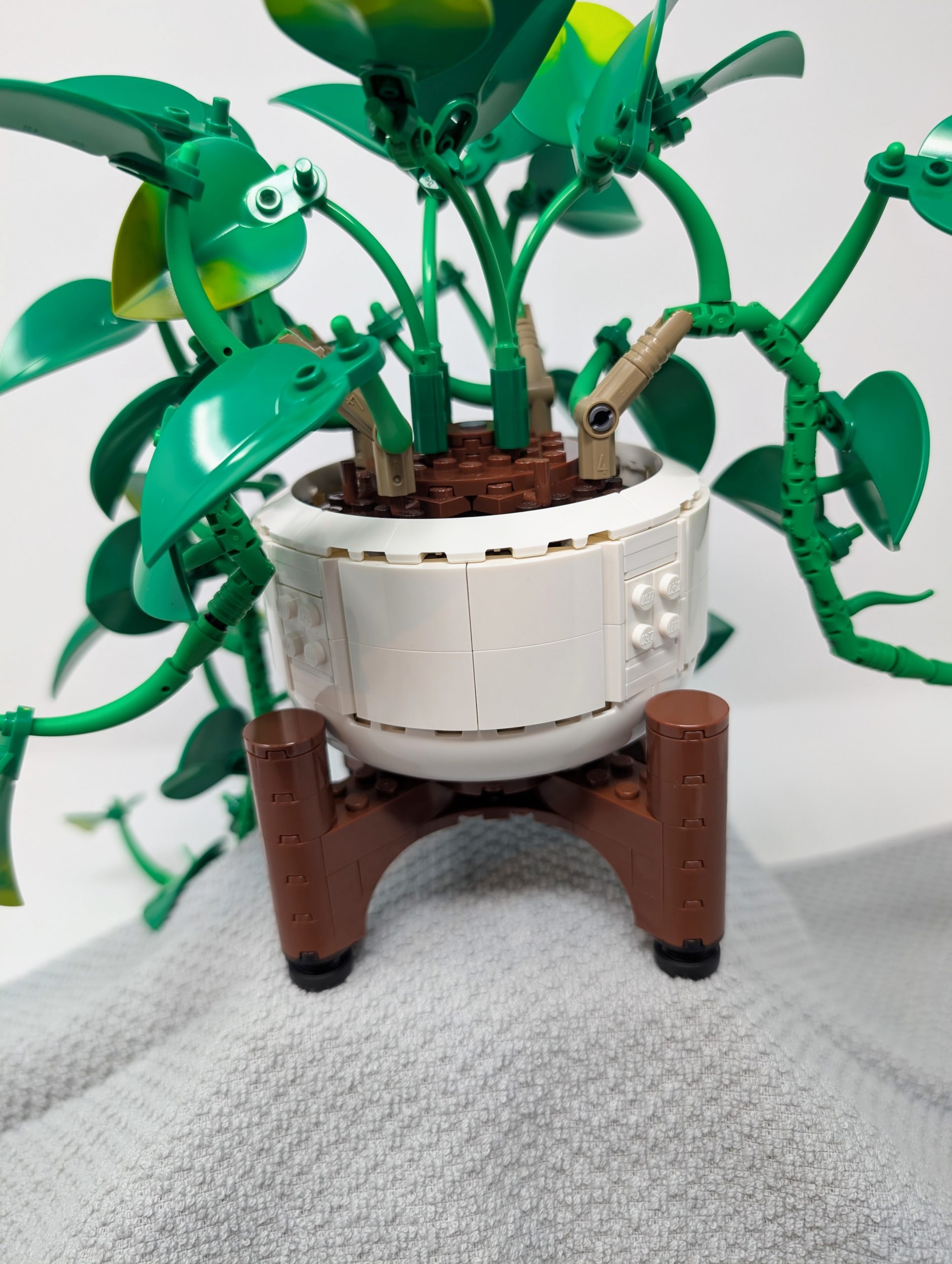
The curvature of the pot is simple yet elegant.
A substantial amount of the model’s bulk comes in the construction of the stand and pot. Although simple, the 192Reddish Brown stand and contrasting 1White pot are a mixture of elegant and practicality, with its rounded shape providing a smooth aesthetic. The designers knew that this would be a display piece and as such took care to ensure that all angles are finished to provide variety in display options. While a niche addition, the inclusion of rubber tires at the bottom of the stand allows the stand to not scratch whatever surface it is sitting on and at the same time provide friction to prevent it from tipping over. Something that could happen on smooth surfaces if the user opts to design the vines to hang low. The stand reminds me of those we see in many other potted Botanicals sets, and hey, if it works why not replicate such effective design patterns.
Leavy Vines
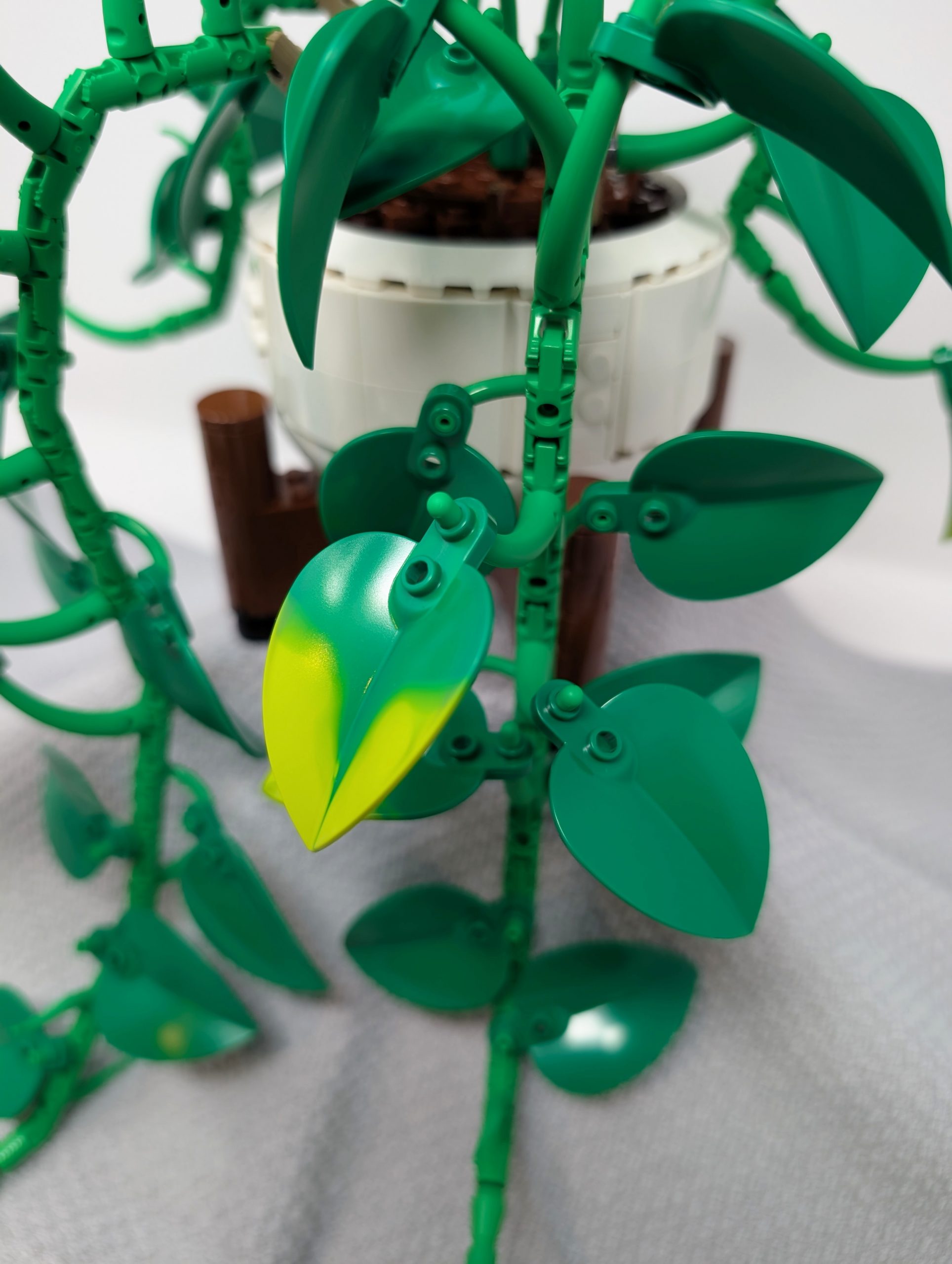
Varied colors pop out to the builder.
While the pot and stand make up a lot of the bulk in terms of mass, the snaking leafy vines make up the bulk of volume through effective use of space. Thin click joint technic joints allow for long snaking vines, with system horn pieces, both in 37Bright Green creating the base of the leaves. To break up the colors a bit a 28Dark GreenGreen and variegated 28Dark GreenGreen and 119Bright Yellowish GreenLime blend leaves litter the vines all the way down. This blend is beautiful and I love when LEGO create dual-moulded pieces. #11512 Hanging Golden Pothos contains twelve two-toned gradient leaves which are placed interlacing the monotone leaves to help create a natural look. The click hinge element while great for allowing for shaping also allows for variability of lengths and you can lengthen or shorten the stems to perfectly fit on your shelf The instructions actually showcase two different layouts to highlight how you as a builder can customize. Because there is customizability, purchasing more copies of this set effectively allows you to expand on this versatile evergreen and as such can let it grow as long as you want, or as long as weight and gravity allows before tipping over.
Real World Comparisons
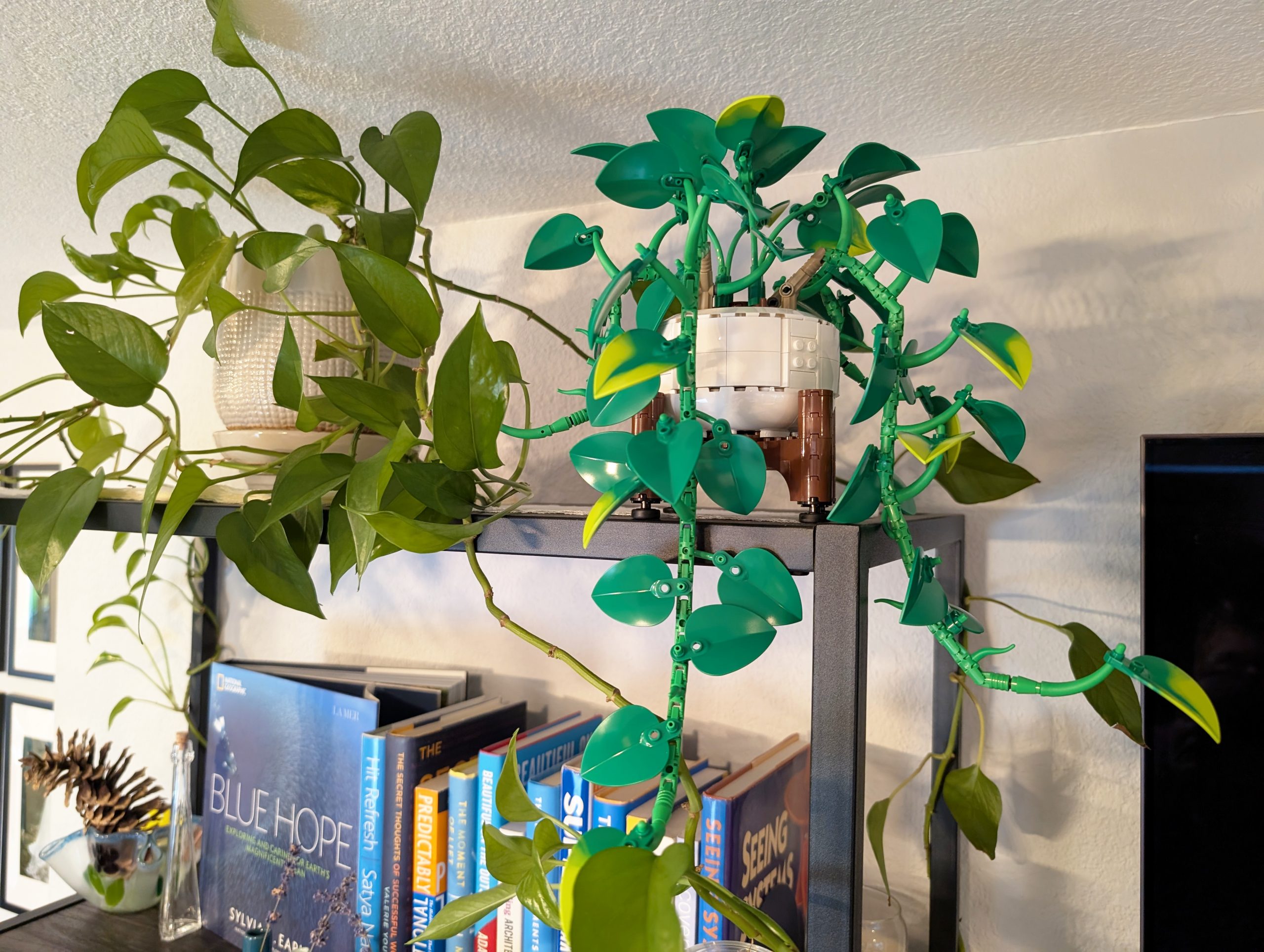
The LEGO variant looks similar to the real life variant.
As mentioned previously, I love a good healthy Pothos, and as such the best way to see how the LEGO variant compares is to place it besides a real life version. While my real life counterpart has vines growing nearly 6 feet, the LEGO version falls a bit short. With a few extra copies and extensions it may one day reach the lengths of my real life version. When comparing the plants the designers did a great job at capturing the colors through vines and leaves, especially the variegated leaves, highlighting beautiful color choices that help simulate the natural flowing color. While colors are what stand out at first, the use of click joint hinges allows for a very snakey vine shape, effectively emulating the shapes and flow of a real life Pothos.
Dark Flower Arrangement
Unlike the Pothos, #11513 Dark Flower Arrangement opts for a darker moodier theme as the flower display leans into shadowy dark hues to give a artful yet timeless look. For those familiar with the Botanicals theme, these flowers are more aligned to the traditional flowers that we build, with each flower using a creative use of elements and colors to form the unique shapes of the flowers accurately. This display piece is made up of seven different types of flowers, with leafy sprigs interspaced to break up the color, each of which we will explore in this set. While not advertised heavily, this set is designed to be combined with other botanicals, notably #11514 Cosmos Flowers. This add ons lack of inclusion doesn’t make this set worse, instead helping lower the price to make this set more accessible.
Moving away from traditional Botanicals, #11513 Dark Flower Arrangement serves more as a centrepiece bouquet, opting to not use traditional long stemmed flowers, instead with each being attached to a centre platform. This platform takes up a sizable number of pieces and other than providing a sturdy base is hard to see and doesn’t offer much to me. I would have preferred if each flower had its own stem so this set’s flowers can be placed alongside the existing bouquets that we have. This could have been remedied had LEGO provided extra pieces to allow you to switch the designs, but that would have driven costs up which would not be desired.
Dark Red Rose
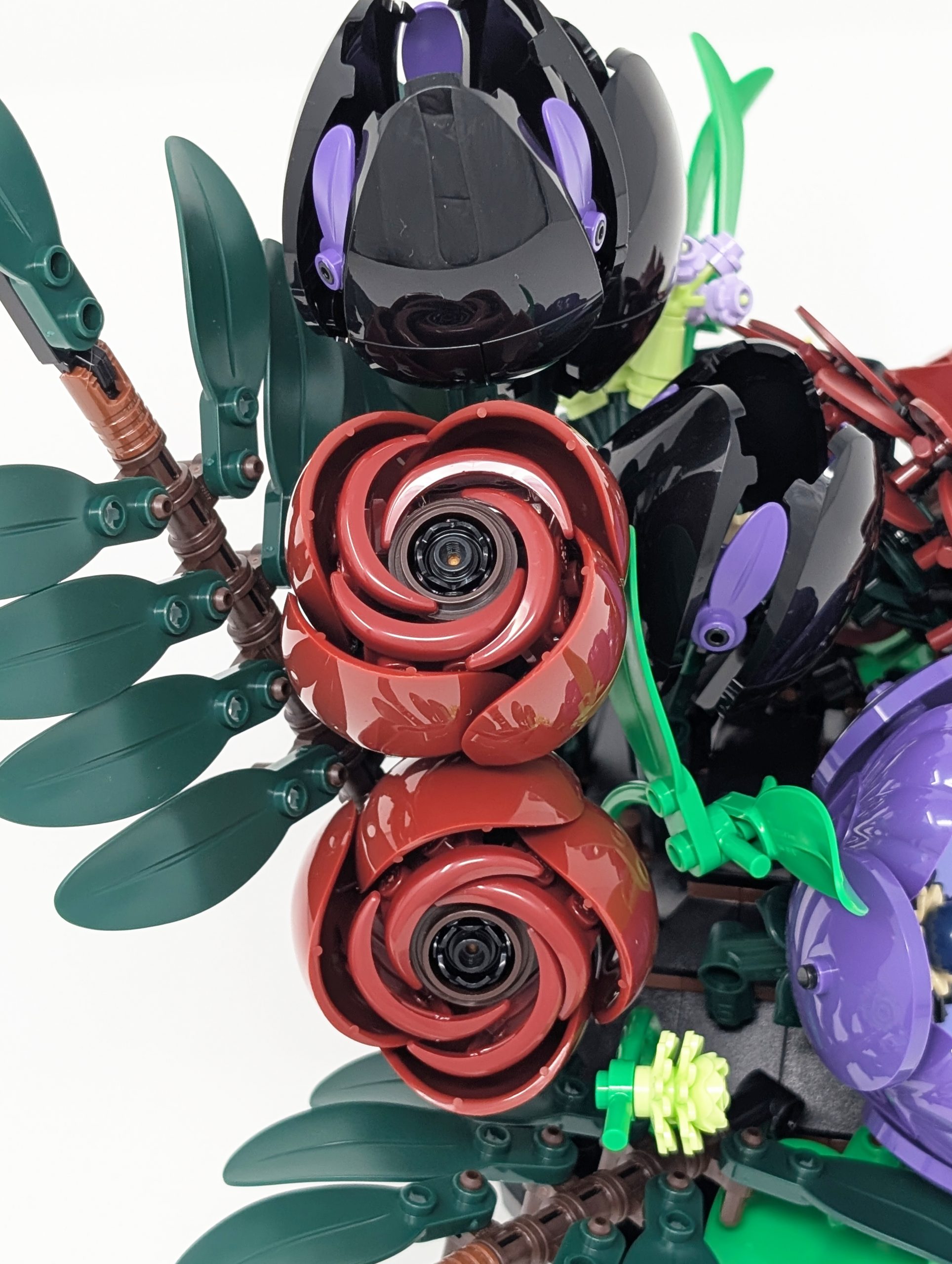
The rose is perfectly designed.
The 154Dark Red of the rose immediately catches your eye, giving a deep sense of luxury. I prefer the darker color choice to the more bright 21Bright RedRed version as it fits the general theme of this set better. Two roses are included in this build, each using the tried, tested and effective mudguard technique to get the spiral inner petals of the flower. Narrowing into the centre a new cabbage piece sits at the centre to create six mini petals. Of all the flowers this is probably my favorite as it captures the real life flower’s appearance beautifully.
Petunia
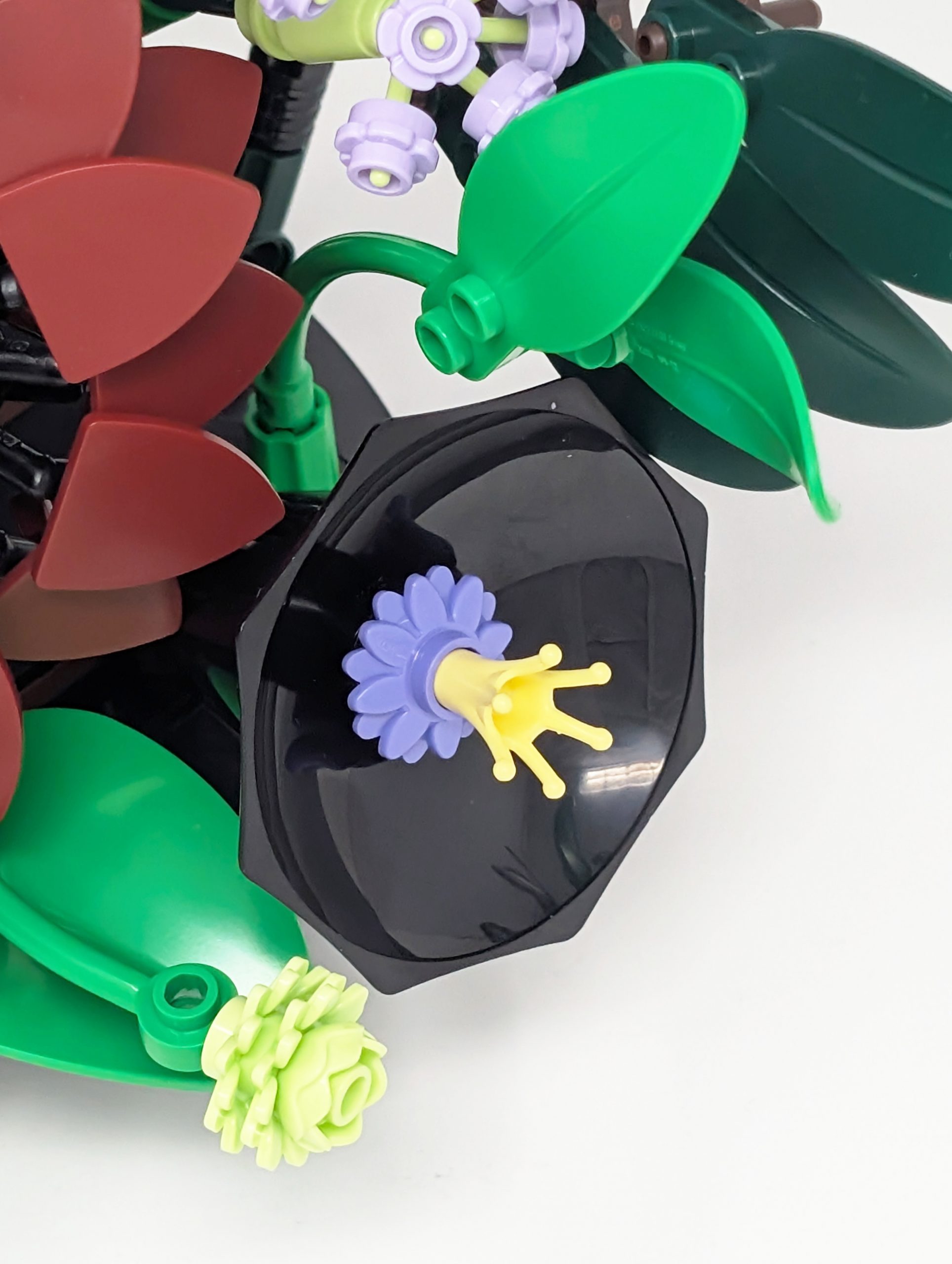
The petunia was hard to recognize.
Where the rose is a strong flower, the petunia is in my opinion the weakest. This flower is built with less than 10 parts and is rather simple. A 26Black umbrella piece makes up the bulk of the flower, and if you had not told me what flower this was I would have been hard pressed to name it. Fortunately the designers tell you what each flower is before you build it, providing an image of the real life counterpart. In this case the addition of the real life version makes this flower look weaker.
Purple Anemone
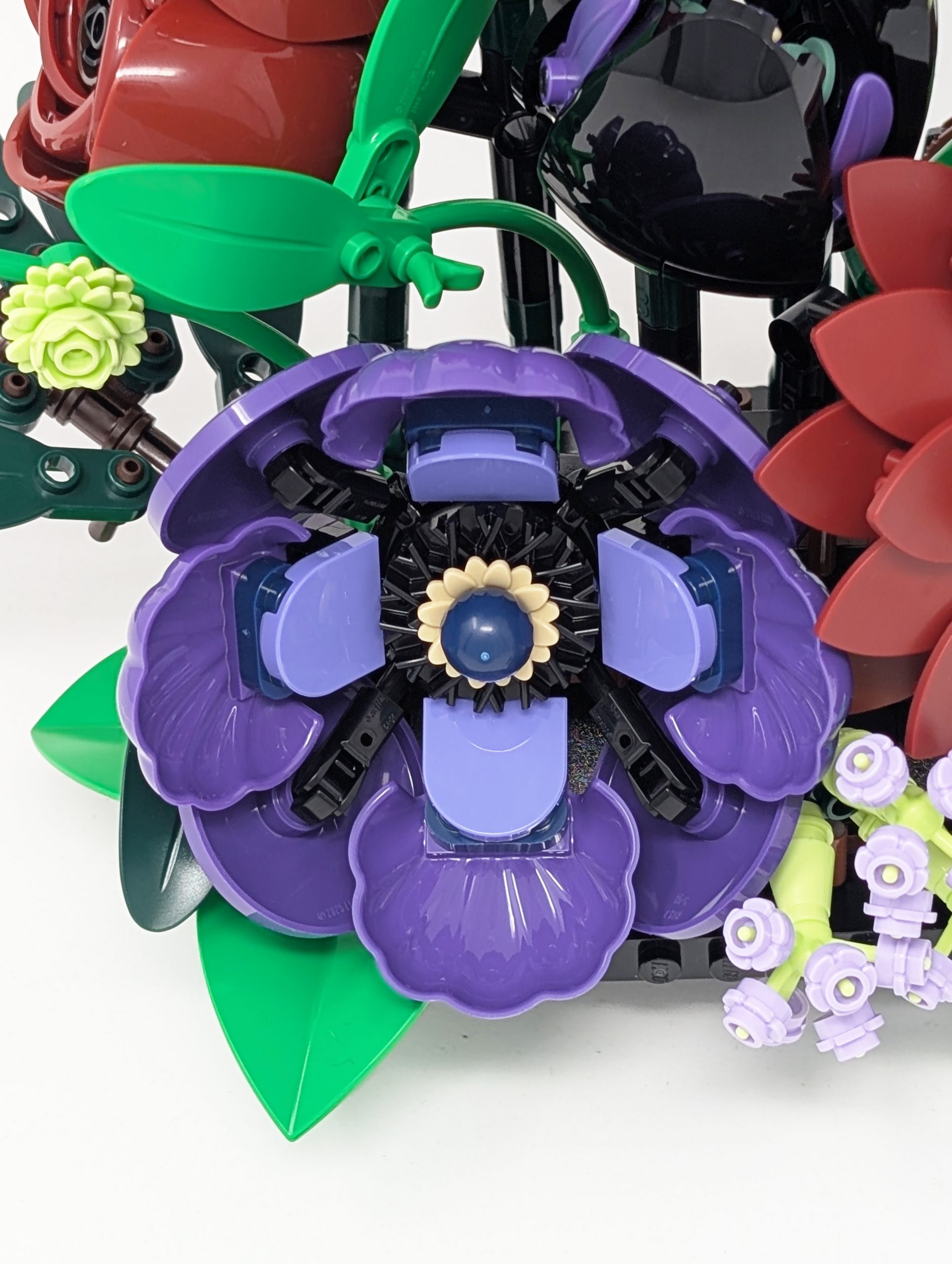
Different hues blend together beautifully.
Not to be confused with the underwater anemone, this beautiful wildflower was historically used as a gift as it was said to help ward off evil. This history makes it a perfect addition to this gothic themed display. Using both 268Medium LilacDark Purple and 324Medium Lavender the gradual lightening towards the centre of the flower is captured beautifully, highlighting how natural blends of color are more effective than monotone colors. While the purple anemone is an inland flower, the designers drew from its oceanic counterpart and built the petals using seashell elements. This tiny inclusion shows the amount of care and level of creativity that one can take to build some beautiful flowers.
Dark Red Dahlia
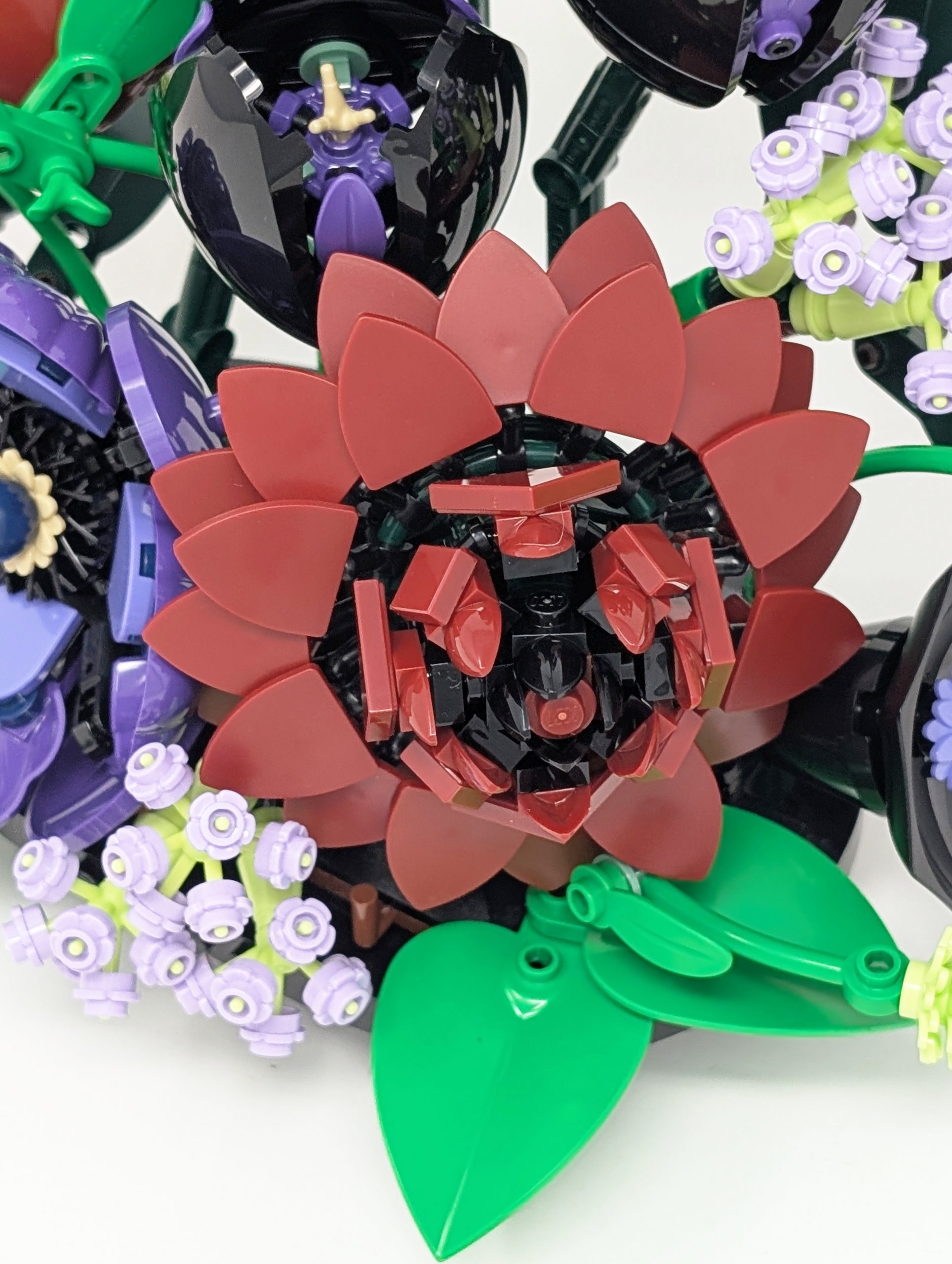
Botanicals always make fun use of simple pieces.
As a fan of the LEGO Castle theme shields are no stranger to me. Built with a whopping 24 shields in 154Dark Red this is my favorite of the flowers, not due to the shields, but due to its creativity in design. The sharp edged shields angled using skeletal arms create the layered petals effect beautifully, while a tooth littered centre of the flower creates a mirrored 154Dark Red envelope against the 26Black centre. This flower is huge and beautiful, matching the color palette of the rest of the build while adding something different due to its more sharp edges. This contrast against the smooth other flower petals help it stand out and draws your eyes to it.
Black Tulip
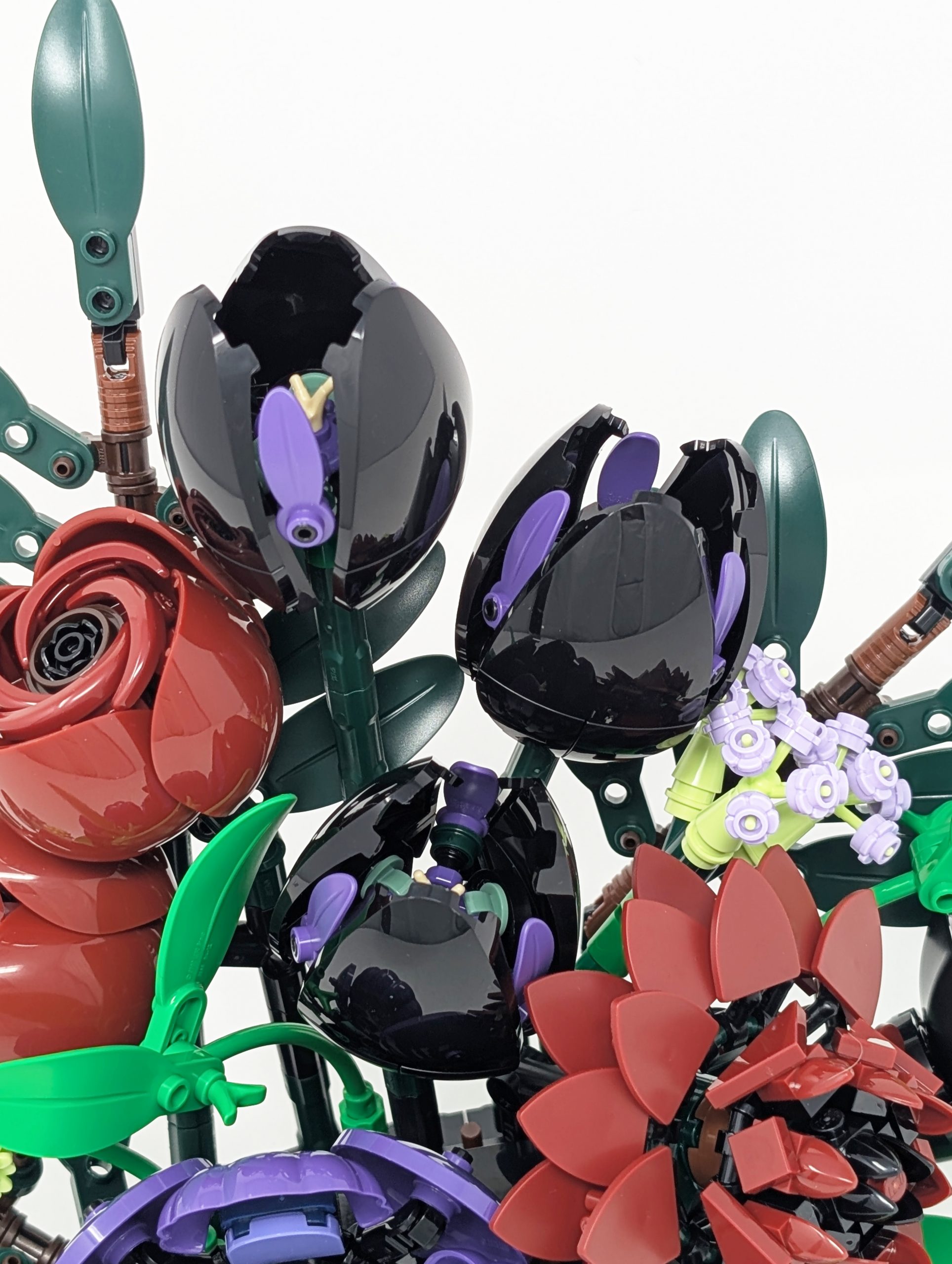
Tulips are immediately recognizable.
As someone who is Dutch one would think the iconic Dutch tulip would be my favorite, but with all the great flowers it is hard to call. Black tulips do not exist in real life, rather they are closer to a very dark purple which is possible with careful selective breeding. This set contains three of these flowers that capture their real life counterpart effectively. Two sets of petals, one large set in 26Black and a smaller set in 268Medium LilacDark Purple create the natural bulb shape almost looking like an egg that is opening from the top. The interlaced colors captures this blend of black and purple emulating both shapes and colors effectively. I love the singular leaf pieces that LEGO has been releasing and in this flower alone we see that variety allows for more different shapes to be created.
Pimpernelli
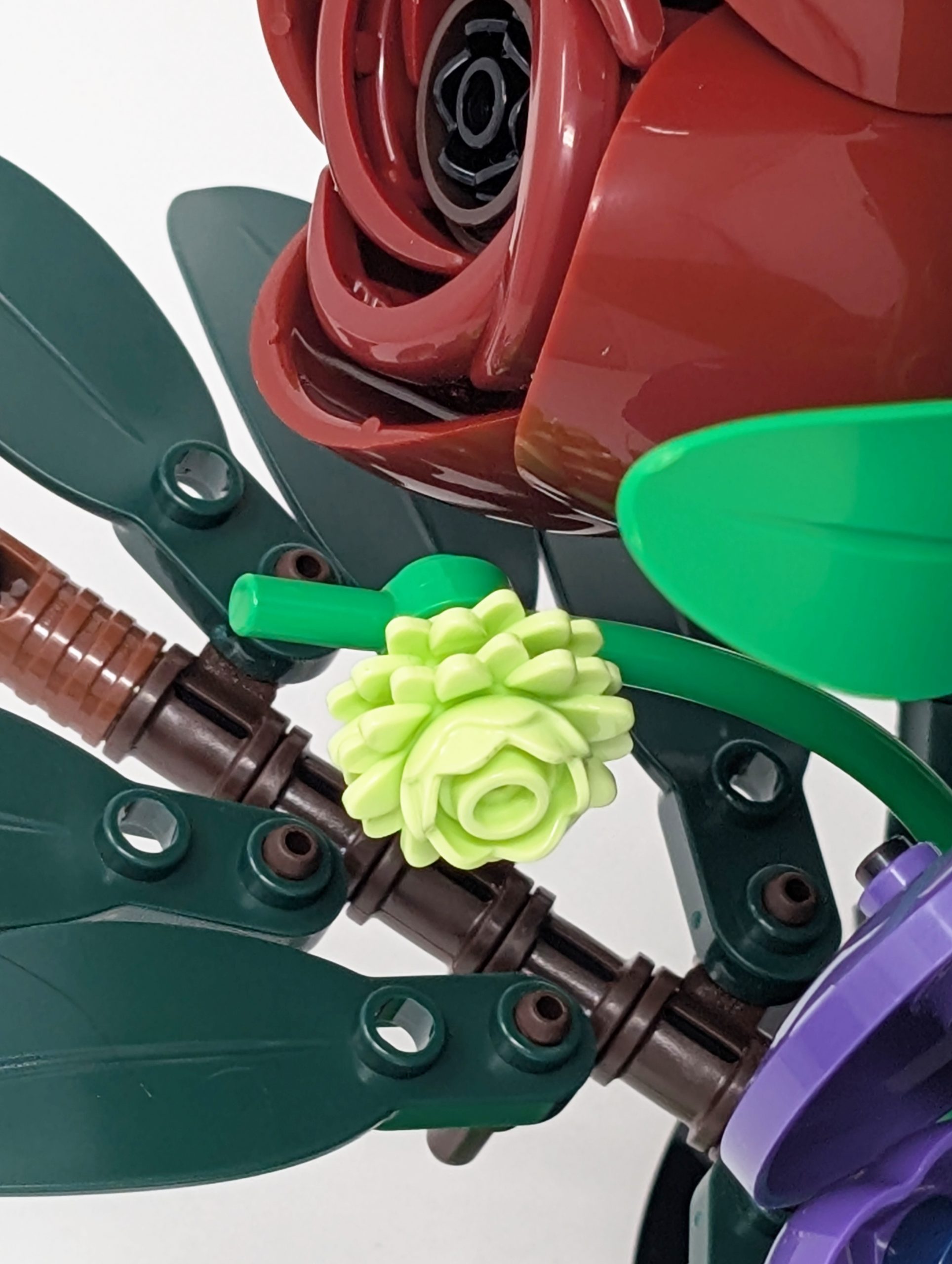
Even small flowers can add value.
This perennial is the smallest of the flower, built with only five pieces. Simplicity however is utilized to the maximum with 326Spring Yellowish GreenYellowish Green flower and cabbage pieces adding a lighter flourish to the bouquet. The stem is built using a curved bar piece that often comes in 40Transparent Trans-Clear and is used for action pieces. This is one of my favorite pieces and in 37Bright Green works effectively as a thin stem.
Light Purple Mistflower
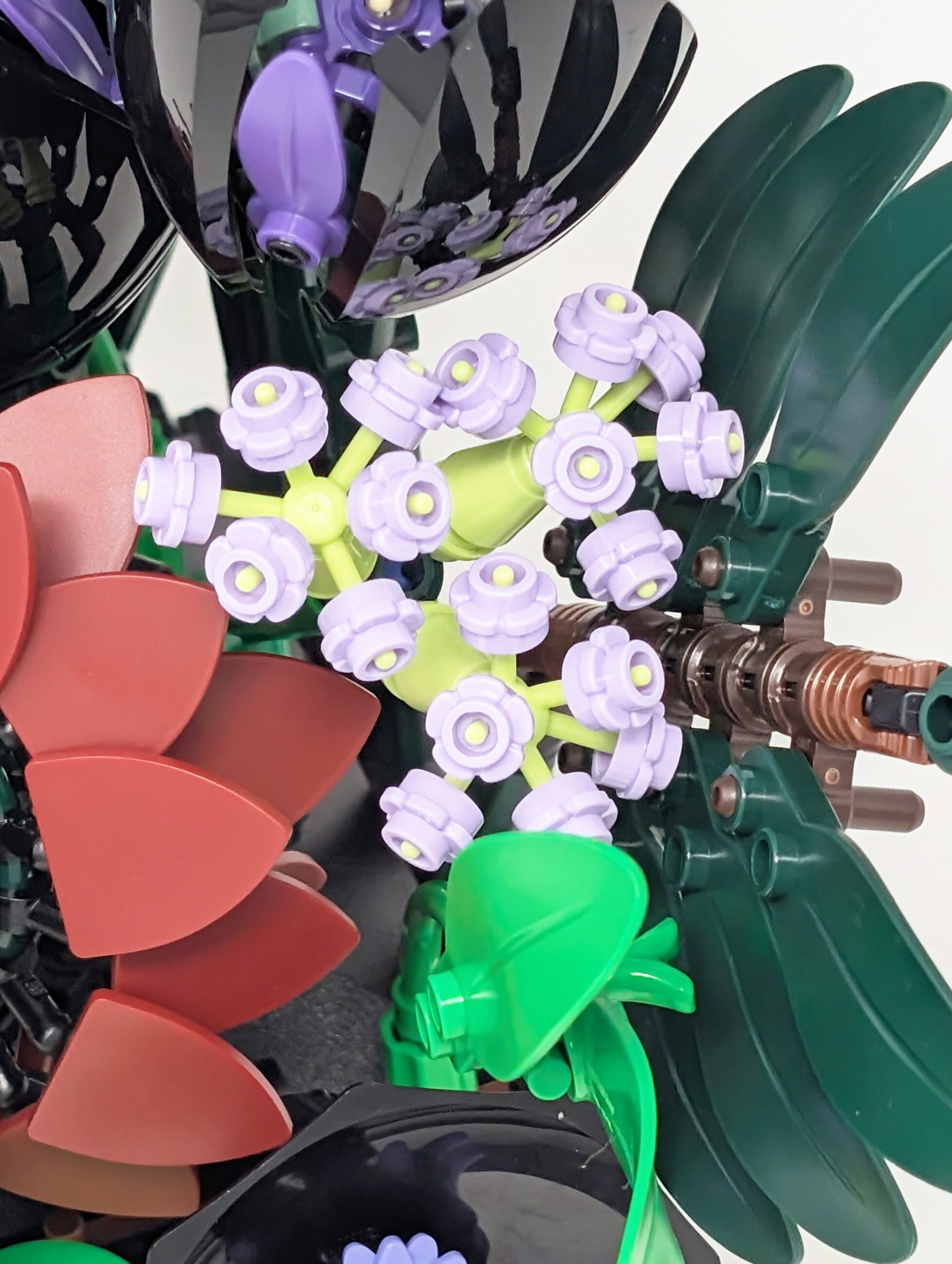
Flowers don’t have to be large to be effective.
This Eastern United States native is a simple flower to put together, using only 30 pieces, of which 18 are flowery studs. Two are included in this set and this flower serves primarily as filler flower to add some contrast with its brighter 325Lavender flowers to fill in empty spaces from the large flowers. This is not a detractor as it serves its role and looks accurate, but there is not much that wows me. This flower would be an easy flower people can put together with parts in their collection and the design of each set of flowers even works nicely as shrubbery at minifigure scale.
Conclusion
Both of these sets have their niche, so you may find yourself drawn to one of them but not the other.. As a fan of the real life counterpart, I was biased going into this article but #11512 Hanging Golden Pothos met and exceeded my expectations. Even though it was designed to allow you to combine multiple versions easily, even just one copy looks great. Everything from the stand to the vines and leaves are simple but effective. The only main design fault is how repetitive the vines can be, but repetition is part of the game when it comes to Botanicals and as such those who are into these sets are aware of this. Where fault does lie is with pricing. $59.99 for this set is honestly absurd, in my opinion being 35% higher than it should be. LEGO definately knows this will be a hit and as such as priced it accordingly. While I was leaning towards giving it an almost perfect score, the greedy pricing bumps #11512 Hanging Golden Pothos down to a 4/5 Recommended rating.
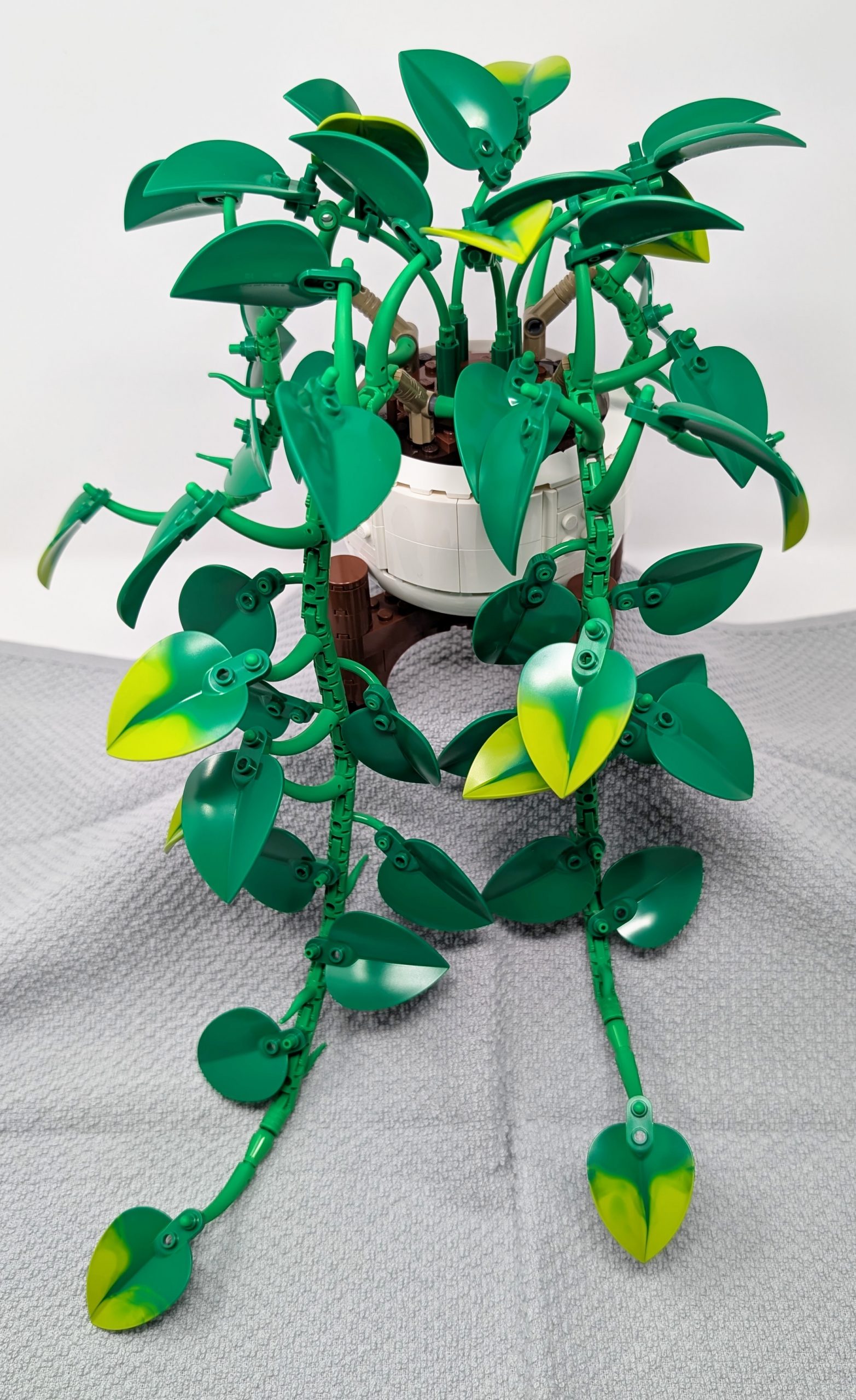
This plant is amazing and will be a hit.
Turning a leaf to instead look at #11513 Dark Flower Arrangement we see variety come into effect. With a whopping seven flowers included, and more if you count the leafage there is a lot to build. This feels more like a traditional Botanicals set. While the builds were fun nothing wowwed me with a lot of the techniques being similar to that of previous sets.
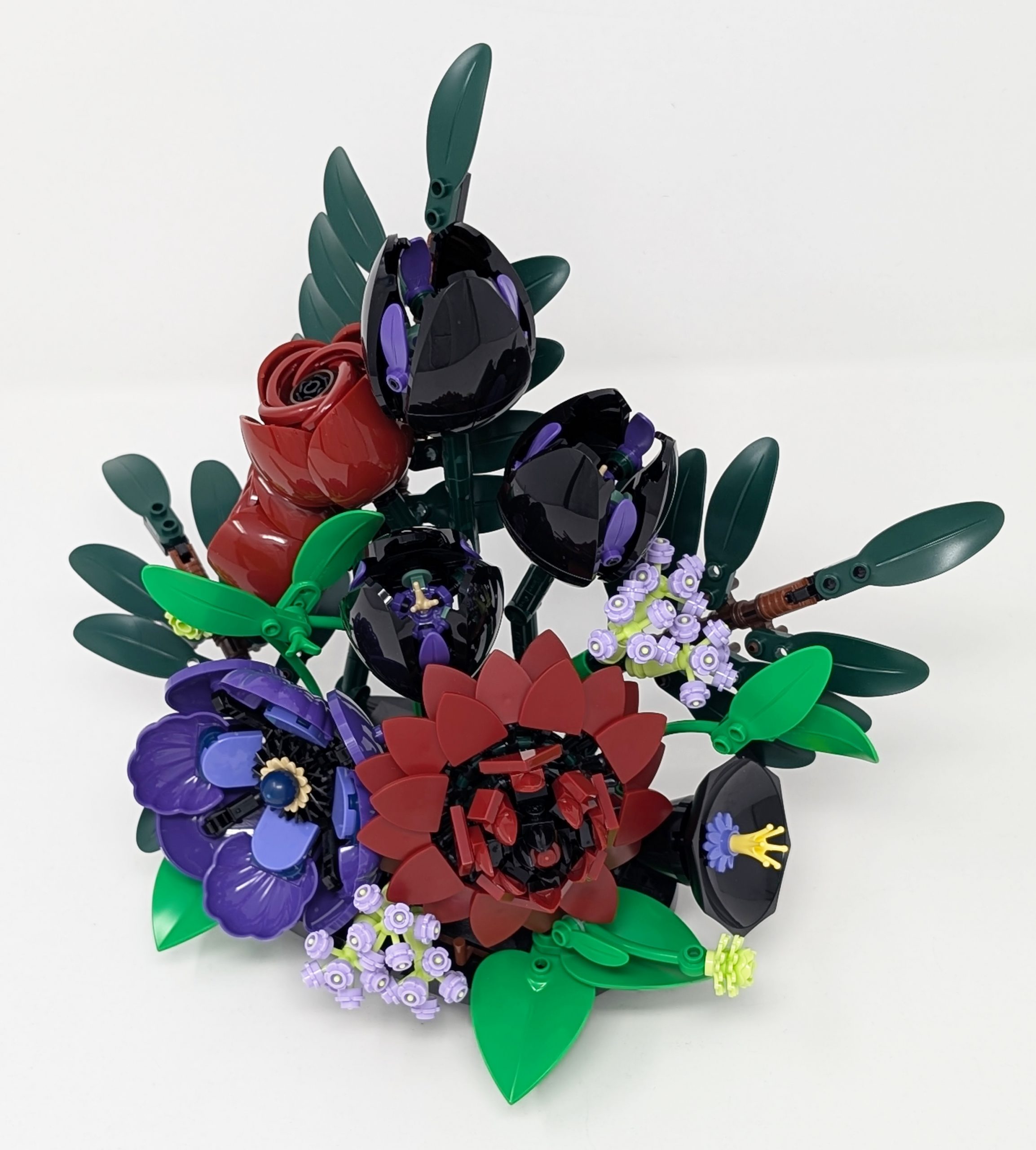
An eclectic bunch when displayed together.
The lack of stems for these flowers is also a big downside for me as this set feels more like a table centrepiece than flowers you can put in a vase. I wish there were both options available to allow for flexibility. All things considered it is still a good set and as such give #11513 Dark Flower Arrangement a respectable 3/5 Good rating.
One thing I liked about both sets is the way you can buy one copy to keep the price lower or buy multiple copies to expand your display. While a larger set overall feels like an omission at first, lowering the barrier to entry for sets is something that I hope to see more of in the future.